
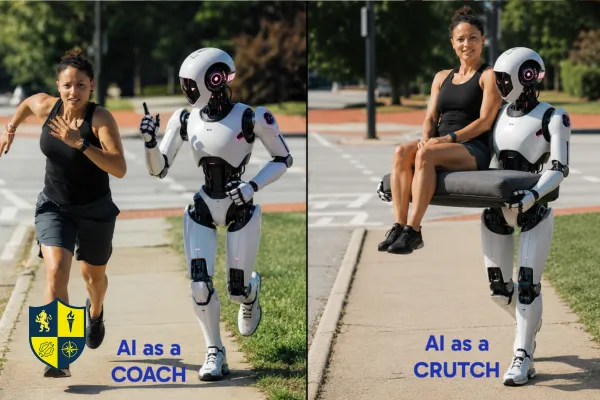
AI Coach or AI Crutch? The Choice That Could Shape Your Teen’s Mind
“A growing number of research studies have identified ways in which AI technologies can enhance children’s development across various domains, including creativity, attention, language acquisition, socioemotional well-being, science and math learning.” - Ying Xu - Harvard AI Education Specialist
Economists use the term “K-shaped economy” to describe a situation where people begin in the same economy but move in sharply different directions. One group rises while another falls further behind.
AI may create a similar divide in the intellectual development of the rising generation.
The upper arm of the K could include young people who use AI to learn faster, ask better questions, test ideas, develop skills, and create things that would have been far beyond their reach a few years ago.
The lower arm could include young people who gradually surrender the difficult work of thinking. They may complete more assignments while understanding less, produce polished work they cannot explain, and become increasingly uncomfortable whenever a task requires patience, memory, imagination, or independent judgment.
Some people call this “brain rot.” Others call it the dumbing down of a generation. “Brain rot” is not a medical diagnosis, but the underlying concern is reasonable.
The question is no longer whether teenagers will have access to AI. The question is what kind of mental habits they will build while using it.

It is crucial that parents understand that AI can function as a coach or as a crutch.
A crutch carries mental weight the student should still be learning to carry.
A coach improves the student’s effort and helps the student become more capable over time.
The Research Already Shows the K Taking Shape
Last year, MIT researchers released an AI study:
Students who leaned on AI for essay writing showed weaker cognitive engagement than students who wrote without it.
Around the same time, Harvard researchers showed something almost opposite:
Students using an AI tutor learned about twice as much in less time.
So which is it?
Is AI helping students? Or is it hurting them?
The answer is... BOTH.
It depends entirely on how they use it.
Families do not need to ban AI to protect their children’s minds. They do need to teach young people how to keep their minds in the driver’s seat.
Here are six examples of common AI use to demonstrate the difference between the crutch and coach approach.
1. Starting a Writing Assignment
AI as a crutch
A teen receives an assignment to write about whether social media has improved society.
Before forming an opinion, reading the source material, or writing a single sentence, they type:
“Write me a five-paragraph essay arguing that social media has improved society. Make it sound like a tenth-grade student.”
Within seconds, the assignment appears finished.
The teen may change a few words, add their name, and submit it. The document looks competent, but almost none of the competence belongs to the student. They did not choose the argument, organize the reasoning, evaluate the evidence, or struggle to express an idea clearly.
They completed the assignment without receiving much of the education hidden inside it.
AI as a coach
Another teen begins by reading the material and deciding what they actually think. They create a rough thesis and three possible supporting points.
Then they ask AI:
“Here is my argument and outline. Do not rewrite it. Identify the weakest part of my reasoning and ask me questions that will help me strengthen it.”
AI may point out that one claim lacks evidence or that the teen has ignored a strong counterargument.
The teen revises the essay in their own words. AI helped improve the work, but the student still did the thinking and remained the author.
What parents can do
Before a teen uses AI for writing, ask to see something that existed first: notes, an opinion, a rough outline, or an opening paragraph.
A useful home rule is:
Original thought first. AI feedback second.
2. Getting Stuck on a Math Problem
AI as a crutch
A teen encounters a difficult algebra problem and immediately uploads a photo:
“Solve this and show the work.”
AI produces a clean sequence of calculations. The teen copies them onto the page and moves on.
The homework is correct, but the confusion remains. On the test, the AI will not be sitting beside them, and the student may not even recognize which step they failed to understand.
This is one reason AI-assisted performance can be misleading. A student can appear to be succeeding while their unaided ability is quietly weakening.
AI as a coach
A teen tries the problem first and gets stuck after the second step.
They tell AI:
“Do not solve this for me. Look at my work, tell me where my reasoning first went wrong, and give me one hint.”
AI identifies the error and asks the teen what operation would preserve both sides of the equation.
The teen tries again. If needed, they request another hint. After solving the problem, they complete a similar one without assistance.
If they still are struggling, they ask AI:
“Explain this math principle to me in an age appropriate way so that I can better understand the point and process.”
In this case, AI acted more like a patient tutor than an answer machine.
What parents can do
Teach your teen to ask for the smallest amount of help necessary.
The progression can be:
Try independently.
Ask for a hint.
Ask for an explanation.
Request a worked example only after genuine effort.
Solve a new problem without AI.
The goal is not merely to reach the answer. It is to leave with more ability than they had before.

3. Studying for a Test
AI as a crutch
A teen has a history test tomorrow but has barely studied. They upload the chapter and ask:
“Summarize everything I need to know.”
AI produces a neat study guide. The teen reads it once and feels familiar with the material.
Familiarity can feel like learning, but recognition is not the same as recall. Reading an intelligent summary creates the comforting sensation that the information has entered the brain, even when very little can be retrieved without looking.
AI as a coach
Another teen studies the chapter and then asks AI to test them:
“Quiz me one question at a time. Do not show me the answer until I respond. Keep track of what I miss and return to those topics later.”
After each answer, AI asks the teen to explain their reasoning, corrects misunderstandings, and increases the difficulty.
At the end, the teen closes the screen and writes everything they remember on a blank page.
AI did not merely compress the information. It created active practice.
What parents can do
Encourage AI activities that require retrieval:
Practice questions
Flashcards
Oral quizzes
“Teach it back to me”
Explaining mistakes
Writing from memory
A good final question is:
“Can you still explain this in your own words, with the screen closed?”
4. Developing a Creative Idea
AI as a crutch
A teen is asked to create a short story, business idea, science project, or video concept.
They type:
“Give me ten creative ideas.”
They select one, ask AI to develop the characters, plot, title, dialogue, visuals, and presentation.
The finished project may look impressive. The teen, however, has mostly served as a project manager for the machine.
Over time, this habit can train a young person to distrust the awkward beginnings of their own imagination. Every blank page becomes something to escape rather than explore.
AI as a coach
Another teen begins with an imperfect idea of their own.
Perhaps they want to write about a boy who discovers that his town’s helpful robot has been quietly making everyone less capable.
They ask AI:
“Help me explore this idea. Ask me questions about the character, setting, conflict, and ending. Do not invent the story for me.”
AI asks what the boy wants, what he fears, and what would make the ending emotionally satisfying.
The teen makes the creative choices. Later, AI may suggest alternate scenes or identify clichés, but the vision remains theirs.
What parents can do
Do not require every first idea to be brilliant. Creativity needs room to be clumsy before it becomes interesting.
Ask your teen:
“What part of this came from you?”
Then follow with:
“How did AI help you develop it?”
A healthy answer should contain both personal ownership and intelligent assistance.

5. Researching an Important Question
AI as a crutch
A teen asks:
“What caused the Great Depression?”
AI provides a confident explanation. The teen copies the answer into an assignment without checking the sources, comparing perspectives, or noticing possible oversimplifications.
The danger is larger than factual error. The teen is learning to treat fluent language as authority.
AI as a coach
Another teen asks AI to help map the question:
“What are the major explanations historians give for the Great Depression? Show where they agree and disagree, and suggest credible primary and secondary sources I should examine.”
The teen opens the sources, verifies important claims, notices that historians weigh causes differently, and forms a conclusion.
They may then ask AI:
“Challenge my conclusion. What evidence might someone use against it?”
AI becomes a research assistant and intellectual sparring partner rather than the final judge of truth.
What parents can do
Teach a simple verification habit for important claims:
Ask. Check. Compare. Decide.
Your teen can ask AI for direction, but they should check original sources, compare more than one credible perspective, and decide what the evidence supports.
The more confident an AI answer sounds, the more tempting it is to skip that process.
6. Completing a Long-Term Project
AI as a crutch
A teen needs to create a presentation, launch a small business, build a portfolio, or complete a science fair project.
They ask AI to generate the plan, schedule, content, branding, script, and final presentation.
The project gets done quickly, but the teen has not developed much planning ability, judgment, resilience, or confidence. When something unexpected happens, they return to AI for every next step.
The tool has become a substitute for self-direction.
AI as a coach
Another teen defines the goal and creates a first draft of the plan.
They ask AI:
“Review this project plan. Identify missing steps, unrealistic assumptions, and the three biggest risks. Then help me turn it into weekly milestones.”
As the project progresses, the teen uses AI to brainstorm solutions, practice a presentation, organize feedback, and reflect on mistakes.
They remain responsible for decisions, deadlines, and execution.
By the end, they have more than a finished project. They have increased their ability to complete the next one.
What parents can do
When your teen shows you an AI-assisted project, avoid making the finished product your only measure of success.
Ask:
What decisions did you make?
What was difficult?
What did you change after receiving feedback?
What can you do now that you could not do before?
Which parts could you reproduce without AI?
Those questions shift attention from impressive output to genuine development.

The Pattern Parents Should Watch For
Across all six of those examples, the dividing line is not whether the teen used AI.
The dividing line is where the thinking occurred.
With crutch use, AI begins the process, supplies the ideas, resolves the difficulty, and delivers the product. The teen receives, copies, and submits.
With coach use, the teen begins with curiosity, effort, judgment, or original thought. AI then questions, explains, critiques, adapts, or challenges. The teen remains mentally active and intellectually responsible.
That distinction gives parents a simple test:
Is AI helping my teen perform this task, or helping my teen become more capable of performing this kind of task?
Sometimes it will do both.
When forced to choose, the second outcome matters more.