
Every Parent on Earth Just Became Jonathan and Martha Kent
“With great power comes great responsibility.”
- Loosely translated from the French National Convention in 1793
Today the U.S. government treated an AI model like it might be powerful enough to threaten national security.
This situation should put something new on the radar of every parent.
To fully understand these implications and why they are relevant in your home, please keep reading.
The first indications of the problem appeared back in April when Anthropic was about to release their latest "Mythos" AI model.
They discovered that its advanced ability to debug code was potentially powerful enough to find flaws in many cybersecurity systems used by corporations and governments across the globe.
Obviously, they couldn't release that to the public. So they delayed rolling out the full tool until they could find a way to remove the possible threat.
Their "bridled" version of Mythos was finally released 3 days ago under the name Fable 5 and apparently something set off the alarm bells in Washington.
The Day the AI Conversation Grew Up
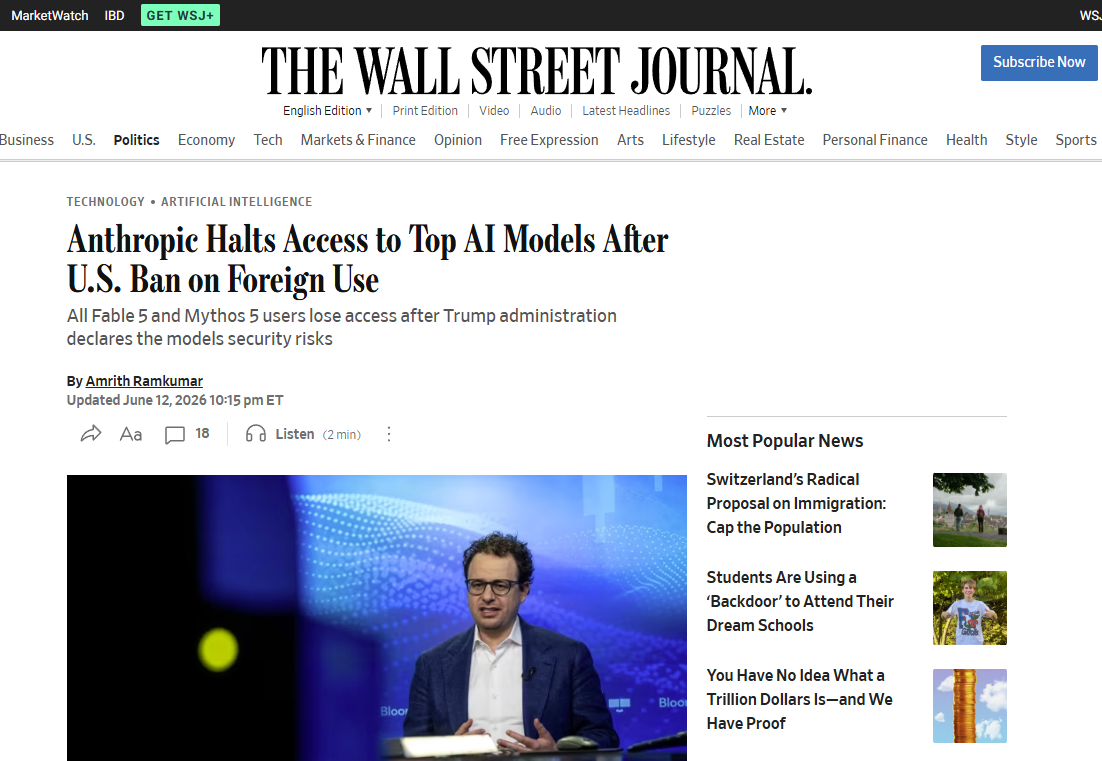
On June 12, the U.S. government ordered Anthropic to suspend access to its latest AI models, Fable 5 and Mythos 5, for foreign nationals. To comply, Anthropic said it had to disable both models for all customers.
The concern was cybersecurity. National security. Software vulnerabilities. The possibility that advanced models could help people find weaknesses in real systems.
Now, there will be plenty of debate about whether the government overreacted. Anthropic clearly believes it did. There will be arguments from engineers, lawyers, national security experts, and AI policy people. That conversation matters.
But for parents, there is a simpler and more urgent lesson:
If governments are now struggling to decide who should be allowed to access the most powerful AI models, families cannot keep treating AI like it is just another app.
The question is no longer, “Will my teenager use AI?”
The question is, “What kind of person is my teenager becoming while using AI?”
Last Year, a High School Student Gave Us a Warning
In Japan, a 17-year-old high school student from Osaka was suspected of using a program generated with help from AI to carry out a cyberattack against a major internet cafe operator.
It is suspected that personal data from roughly 7.3 million customers may have been compromised from both the Kaikatsu Club internet cafe chain and FiT24 fitness gyms.
That number is hard to process.
Seven point three million people.
Not because an army of elite hackers spent years planning a nation-state attack.
According to reports, this was allegedly done by a high school student using AI-assisted code.
Now let’s be careful. This is still a legal case. We should not sensationalize it or pretend we know every detail. But the pattern is impossible to ignore.
AI is lowering the barrier between curiosity and capability.
A teenager who once might have been limited by what they personally knew can now ask an AI system to explain, generate, analyze, revise, and troubleshoot. That can be wonderful when used well.
It can help a teen build an app for a grandparent.
It can help them create a business plan.
It can help them write music, design a service project, learn coding, study history, or build something genuinely useful.
But the same leverage can also amplify poor judgment.
A bored teen with weak boundaries and powerful tools is not a small problem.
It is a parenting problem.
It is a character problem.
The Old AI Fear Is Too Small
For the last few years, many parents have focused on one question:
“Will AI help my child cheat?”
That is a real concern. Academic honesty matters. A teen who lets AI do their thinking for them is not becoming stronger. They are outsourcing the very struggle that builds intelligence.
But cheating is only the front porch of the issue.
The deeper issue is capability without wisdom.
AI can help a teenager write faster, code faster, research faster, imitate faster, persuade faster, and act faster. It can compress years of learning into minutes of guided output.
That is not automatically bad.
A calculator did not destroy math. A tractor did not destroy farming. A kitchen knife is not evil because it can hurt someone. Powerful tools are not the enemy.
But powerful tools require training.
No good parent hands a child a chainsaw and says, “Figure it out.”
No good parent hands a teenager the car keys and says, “The road will teach you.”
And yet how many families are handing teens access to AI with reckless abandon?
Wisdom now requires that we ensure our children understand the new direction the world is heading.
Wise parents say, “Let me teach you what this is, what it can do, what it must never do, and what kind of person you need to become to use it well.”

The Superman Lesson
AI expert, Mo Gawdat, has often compared AI to Superman.
It is a powerful metaphor. Even as a newly arrived baby, Superman displayed unfathomable power.
Jonathan and Martha Kent quickly understood that with such power he would be able to easily rob any bank, commit any crime, or literally conquer the entire world.
They knew that this boy would need to be taught humility, restraint, compassion, and moral purpose if there was any chance he would grow up good.
They did not pretend he had no power.
They taught him what power was for.
But today, the metaphor has expanded.
AI is not the only Superman.
AI gives our children Superman-like leverage.
A teenager with advanced AI may suddenly be able to do things that used to require a team, a budget, a degree, or years of experience. They can build, publish, automate, persuade, design, research, code, and create at a level no previous generation of teens has had in their pocket.
That should excite us.
It should also sober us.
Because every parent on earth just became Jonathan and Martha Kent.
Not because your child is dangerous.
Because your child is suddenly more powerful than they were yesterday.
And power without formation is fragile.
Governments Cannot Parent Fast Enough
Some people will say, “Don’t worry. The government will regulate it.”
Others will say, “The AI companies will build better guardrails.”
Both may be partly true. But neither is enough.
Governments move slowly. AI moves daily.
Companies build safeguards. Teenagers test boundaries.
Schools update policies. Students find new tools before the ink is dry.
That does not mean laws do not matter. They do. It does not mean safety systems do not matter. They absolutely do.
But the first and most important safeguard is not a policy.
It is conscience.
A teen who has been taught honesty, restraint, empathy, courage, and responsibility is safer with powerful tools than the teens who have been granted unrestricted access or those who have been completely blocked from them.
Because every block eventually fails.
Every filter has gaps.
Every rule needs judgment behind it.
The future will not be protected only by better software.
It will be protected by better people.
This Is the Moment for Parents to Wake Up
Parents do not need to become AI engineers.
You do not need to understand every technical detail of AI model architecture, cybersecurity, export controls, or jailbreaks.
Jonathan and Martha Kent were not Kryptonian scientists.
They were parents.
Their job was not to understand every molecular detail of Clark’s powers. Their job was to shape the person who would use those powers.
That is the job in front of us now.
We need to teach our teens to ask better questions:
Not just, “Can AI do this?”
But, “Should I do this?”
Not just, “Can I get away with it?”
But, “Who could this hurt?”
Not just, “Can I make something impressive?”
But, “Can I make something good?”
Not just, “Can AI make me look smart?”
But, “Can AI help me become wise?”
This is the shift parents need to see.
AI literacy is not merely a technical skill.
It is a moral skill.
It is not just about prompts.
It is about purpose.

The Two Dangerous Extremes
There are two responses that will fail our kids.
The first is fear.
Fear says, “AI is dangerous, so my child will not touch it.”
That may feel safe for a moment, but it does not prepare them. It can create secrecy, ignorance, and resentment. It can leave teens untrained in a world that will absolutely require AI fluency.
The second is casual permission.
Casual permission says, “AI is the future, so let them use it however they want.”
That may feel modern, but it is not wisdom. It can create dependency, dishonesty, overconfidence, shallow thinking, and ethical drift.
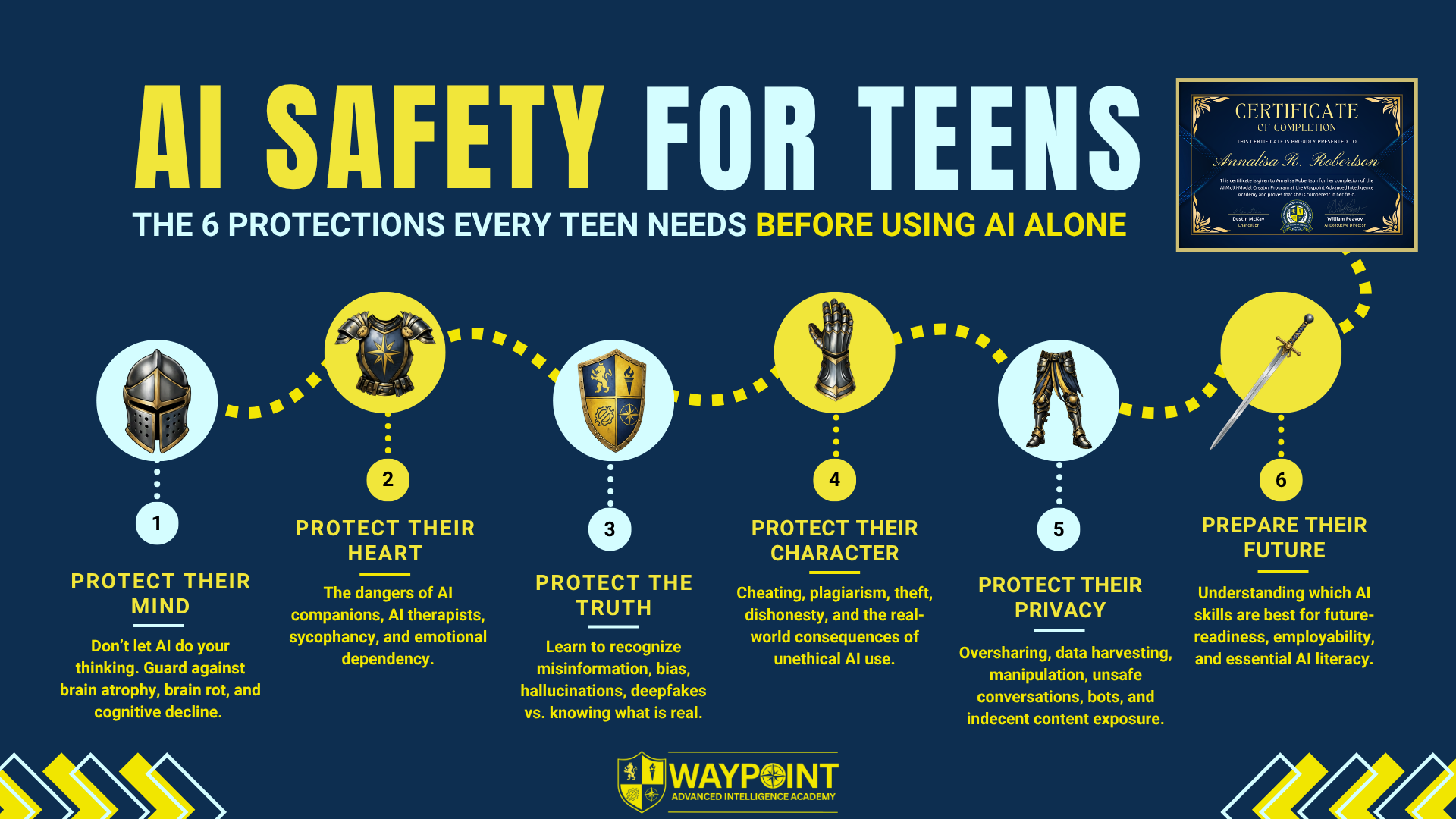
Waypoint exists for the third path.
Guided AI use.
Not no AI.
Not unlimited AI.
Wise AI.
AI as a coach, not a crutch.
A tool, not a toy.
And it is essential it is used with character.
What Teens Need Now
Our teens need to understand that AI can affect real people, real companies, real communities, and real futures.
They need to understand privacy.
They need to understand consent.
They need to understand intellectual honesty.
They need to understand that digital actions can create real-world consequences.
They need to understand that being clever is not the same thing as being good.
And they need something more inspiring than a list of rules.
They need a vision.
They need to see that AI can help them build things that matter.
They can use it to create businesses, solve problems, strengthen learning, serve their families, explore their talents, and prepare for a future that will reward people who combine competence with character.
That is the real opportunity.
The goal is not to scare teens away from AI.
The goal is to help them become the kind of people who can be trusted with it.

Why Waypoint Exists
Waypoint was built for this exact moment.
We teach teens to become responsible creators in the age of AI.
Not passive consumers.
Not shortcut seekers.
Not tech addicts.
Creators.
Builders.
Problem-solvers.
Young people who understand that intelligence without character can become dangerous, but intelligence guided by truth, discipline, and purpose can bless the world.
We teach AI literacy, but we do not stop there.
We teach direction.
We teach discernment.
We teach teens to use AI to strengthen their own thinking, not replace it.
We teach them to build with integrity.
We teach them that the most important question is not, “How powerful is the tool?”
The most important question is, “What kind of person is holding it?”
The New Parenting Question
For years, parents have asked:
“How do I protect my child from technology?”
That question still matters.
But a new question has arrived:
“How do I help my child become safe with technology?”
Because AI is not waiting.
The tools are getting stronger.
The guardrails are imperfect.
The laws are late.
And our children are growing up in the middle of it.
Today’s headlines should not make parents hopeless.
They should make us serious.
Every parent on earth just became Jonathan and Martha Kent.
The world is handing our children power.
Waypoint exists to help parents give them wisdom.