
George Washington Carver Had Peanuts. Your Teen Has AI.
“Start where you are, with what you have. Make something of it and never be satisfied.” - George Washington Carver
George Washington Carver has been one of my heroes for a long time. An amazing man who lived an extraordinary life.
I admire him because his life is such a powerful example of Becoming.
And, for parents of teens today, there are some great lessons in his story.
Carver started with remarkably little, learned to see possibilities other people missed, and devoted much of his life to solving problems that could make life better for others.
Lately I have found myself wondering:
What could happen if we taught our teenagers to approach artificial intelligence the way George Washington Carver approached a handful of peanuts?
Carver's story didn't actually begin with peanuts.
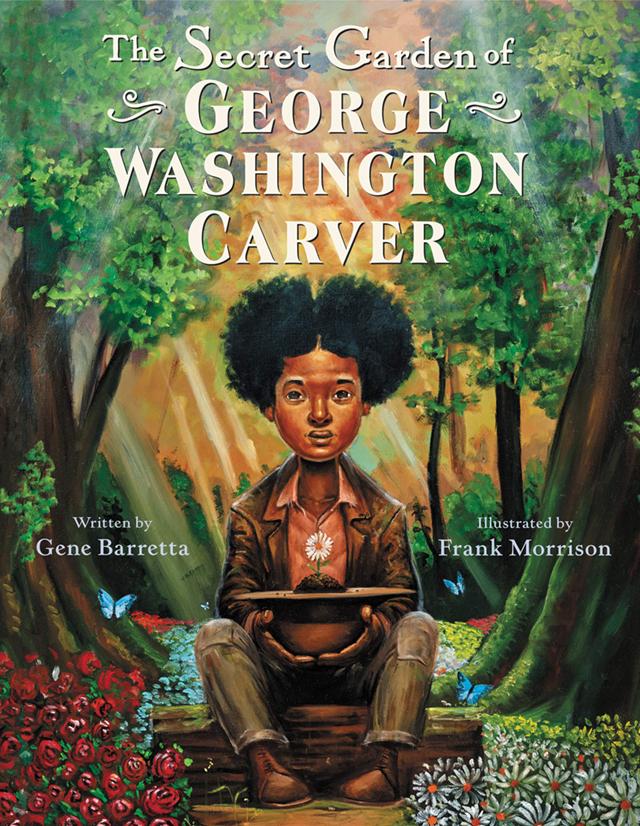
It began with a secret garden.
Before the laboratory, there was a little boy in the woods
Carver was born enslaved in Missouri near the end of the Civil War. As an infant, he and his mother were kidnapped. Carver was eventually recovered and returned, reportedly nearly dead from whooping cough. His mother was never found.
He remained frail and sickly as a child, which meant he often couldn't perform the same heavy physical work as others around him.
But those limitations gave him something else.
Time to think. And time to explore.
Carver wandered through the woods collecting flowers, rocks, insects and plants. He later recalled, "Day after day I spent in the woods alone in order to collect my floral beauties."
He transplanted some of them into a small garden he had hidden in the brush near his home. The National Park Service still refers to it as his "secret garden." There he observed plants, experimented with them and became remarkably good at nursing unhealthy plants back to life. Neighbors eventually began bringing him their struggling plants, earning the young Carver the nickname "the Plant Doctor."
Long before the university degrees.
Before the scientific laboratory.
Before the peanut.
There was a curious kid wandering around in the woods asking, in effect:
Why does this work?
Why did that plant die?
What would happen if I tried this?
What else could this become?
That habit of mind may have mattered more than almost anything else that came later.
Then came a much bigger problem
Years later, at Tuskegee Institute, Carver faced a problem that affected thousands of farming families.
Southern agriculture had become heavily dependent on cotton. Repeated cotton cultivation had depleted the fertility of the soil, while many poor farmers were trapped economically by their dependence on a single cash crop.
Carver promoted crop rotation and encouraged farmers to grow crops such as peanuts and other legumes that could help restore nitrogen to depleted soil.
But solving one problem helped create another.
If farmers planted fewer acres of cotton and more peanuts...
What were they supposed to do with all those peanuts?
This is where the Carver story gets famous.
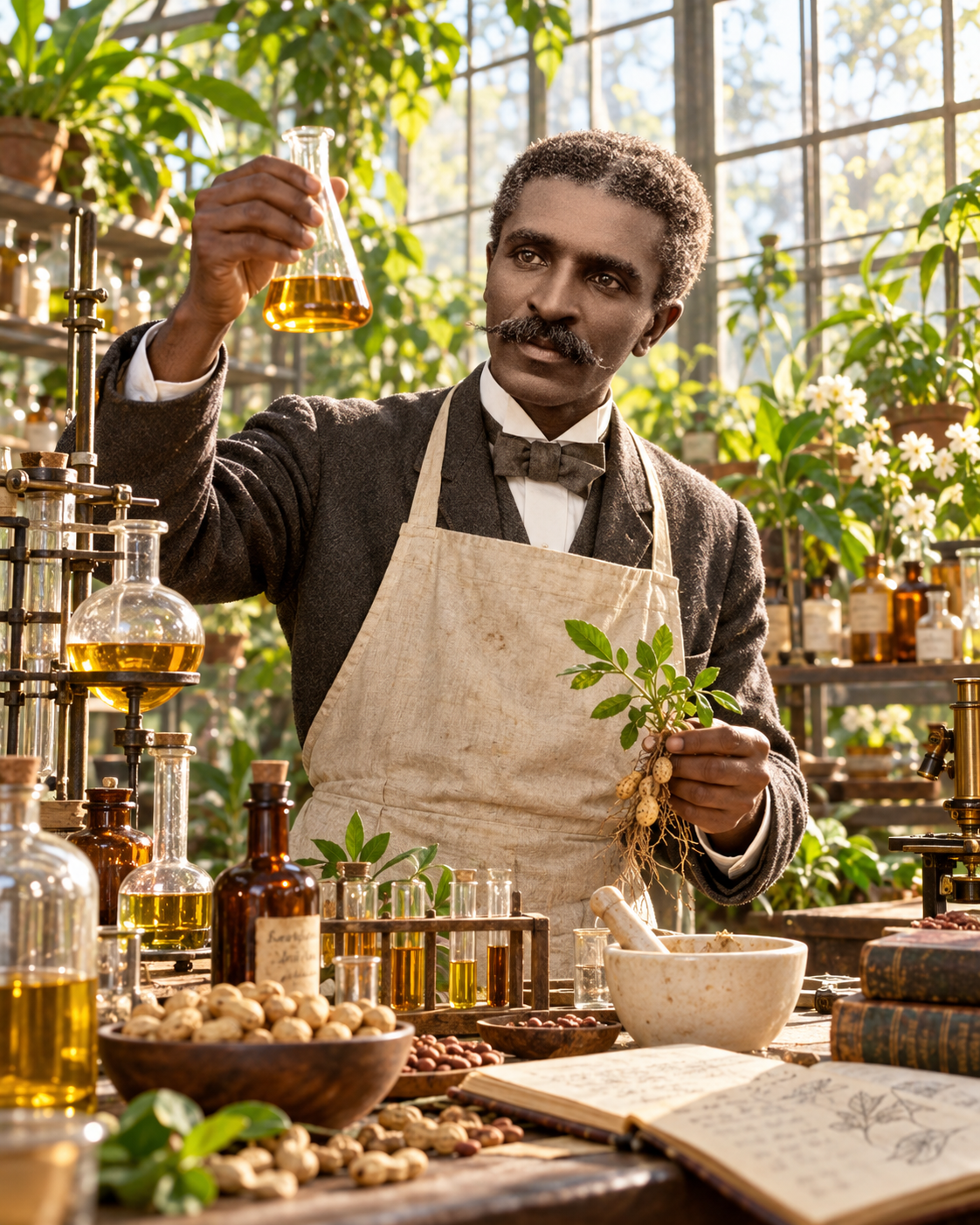
He began experimenting with ways peanuts, sweet potatoes and other crops could be turned into useful foods, household goods and industrial materials.
Carver is commonly credited with developing or cataloguing hundreds of potential uses for peanuts. Some were recipes, adaptations or demonstrations of what could be done with an inexpensive crop.
Carver looked at something ordinary and saw possibility.
Other people saw worthless peanuts.
Carver saw raw material.
Soap.
Ink.
Dyes.
Oils.
Paper.
Cosmetics.
Food.
Dozens upon dozens of experiments.
Some worked. Some didn't. Some were useful. Some went nowhere.
That was the point.
He kept asking:
What else could this become?
Now put AI in the hands of a teenager
Your teenager does not have to begin with a field of peanuts.
They have access to artificial intelligence.
And that is a breathtaking starting material.
AI can help a teenager learn physics, understand computer code, analyze a business idea, research a historical problem, brainstorm inventions, create a prototype, learn graphic design, practice a language, plan an experiment, write software, explore careers or find twenty possible approaches to a problem they noticed in their own community.
A teenager could notice that their grandmother keeps forgetting her medication and begin exploring a simple reminder system.
They could notice how much food their family throws away and design a household food-tracking system.
They could discover that a local nonprofit struggles with social media and build tools to help them.
They could interview a grandparent, restore old photographs, research family history and create an interactive family archive.
They could have an idea for a business on Tuesday and, with enough determination, have a crude working prototype by Saturday.
Used correctly AI dramatically increases what a curious, motivated human being can attempt.

That distinction matters.
The goal isn't to raise children who ask AI to do everything for them.
That would be almost the opposite of Carver.
Carver experimented.
He observed.
He struggled.
He learned.
He tried again.
AI should help our teenagers do more of that, not escape from it.
A coach or a crutch?
Parents are right to be cautious here.
Give a teenager AI and they can absolutely type:
"Write my English paper for me."
"Do these math problems."
"Give me the answer."
That kind of AI use can reduce effort and quietly replace learning.
But the very same teenager can ask:
"I think my community has this problem. Help me understand why it happens."
"Here are three solutions I've thought of. What weaknesses am I missing?"
"Teach me the skills I would need to build this."
"Don't solve this math problem for me. Give me one hint at a time."
"Here is my prototype. Try to break it."
Same technology.
Completely different teenager being developed.
That is why I don't think the most useful question for parents is simply:
"Should I let my teenager use AI?"
We need a better question:
"What kind of person is my teenager becoming while using AI?"
A few simple habits can shift the answer dramatically:
Notice problems. Encourage your teen to pay attention to things that are frustrating, inefficient, expensive, confusing or needlessly difficult.
Think before prompting. Ask them to form an opinion or attempt a solution before bringing AI into the process.
Build something. Move beyond homework. Use AI to create projects, experiments, services, businesses and solutions.
Keep ownership of the thinking. AI can challenge ideas, teach skills and suggest alternatives, but your teen should still make the important judgments.
Serve somebody. Some of the best projects begin with the question, "Who could this help?"
That is AI as a coach, not a crutch.
The unopened sack of peanuts
Sometimes I hear parents talk about AI almost the way they would talk about buying their teenager a new video game.
"I'm not sure they really need that."
"I'm worried they'll spend too much time on it."
"Maybe they're better off without it."
Those aren't foolish concerns. AI has genuine risks. Unlimited, unguided access is not the answer.
But neither is leaving one of the most powerful learning and problem-solving tools ever made sitting untouched in the corner because we haven't yet figured out how to use it wisely.
I keep coming back to Carver.
A frail child wandered into the woods and created a secret garden.
He learned to see what others overlooked.
Later, he looked at exhausted soil and saw restoration.
He looked at poor farmers and saw people he might help.
He looked at a peanut and saw hundreds of possibilities.
[photorealistic split-era image, left side showing George Washington Carver in a simple laboratory examining peanuts and plant samples, right side showing a modern teenager at a workbench using a laptop while building a real physical project, visually connected by curiosity rather than futuristic effects]
That is the part of his legacy I want our teenagers to inherit.
Not peanuts.
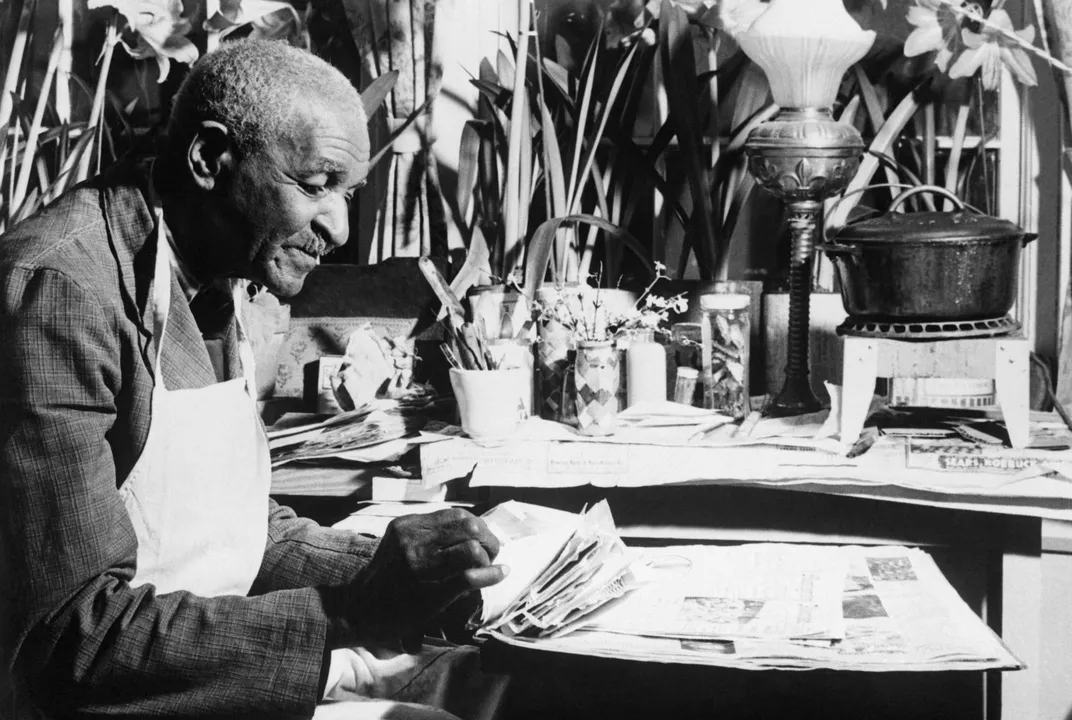
The habit of looking at the world and asking, "What else could this become?"
Carver had plants, soil, curiosity and a stubborn willingness to experiment.
Our teenagers have all of that available to them too.
And now they have AI.
We should be very careful about teaching them how to use it.
But we should also recognize just how extraordinary that opportunity is.
Because somewhere right now there is a teenager who has noticed a problem the adults around them have learned to tolerate.
They may not have money.
They may not have credentials.
They may not have a laboratory, employees, investors or connections.
George Washington Carver didn't start with much either.
Sometimes you start with what is available.
For Carver, it was a secret garden and eventually a field full of peanuts.
For this generation, it might be curiosity, character, a laptop...
and the courage to ask AI, "Help me figure out what this could become."