

Is AI Making Our Kids Dumber? We May Be Blaming the Newest Tool for an Older Problem
“The function of education, therefore, is to teach one to think intensively and to think critically.” - Martin Luther King Jr.
If you have ever watched a teenager paste a homework question into ChatGPT and receive a polished answer ten seconds later, I understand the knot that can form in a parent's stomach.
Wait a minute.
Wasn't the struggle supposed to be part of the learning?
If AI writes the essay, solves the equation, summarizes the chapter and generates the ideas, what exactly is left for the teenager's brain to do?
That is a legitimate concern.
AI really can become a shortcut around thinking. A student can produce work that looks far more sophisticated than what they actually understand. If that becomes a habit, we shouldn't be surprised if the finished assignments improve while the student doesn't.
But before we declare that "AI is making our kids dumber," we need to remember something important.
Kids were struggling long before ChatGPT showed up.
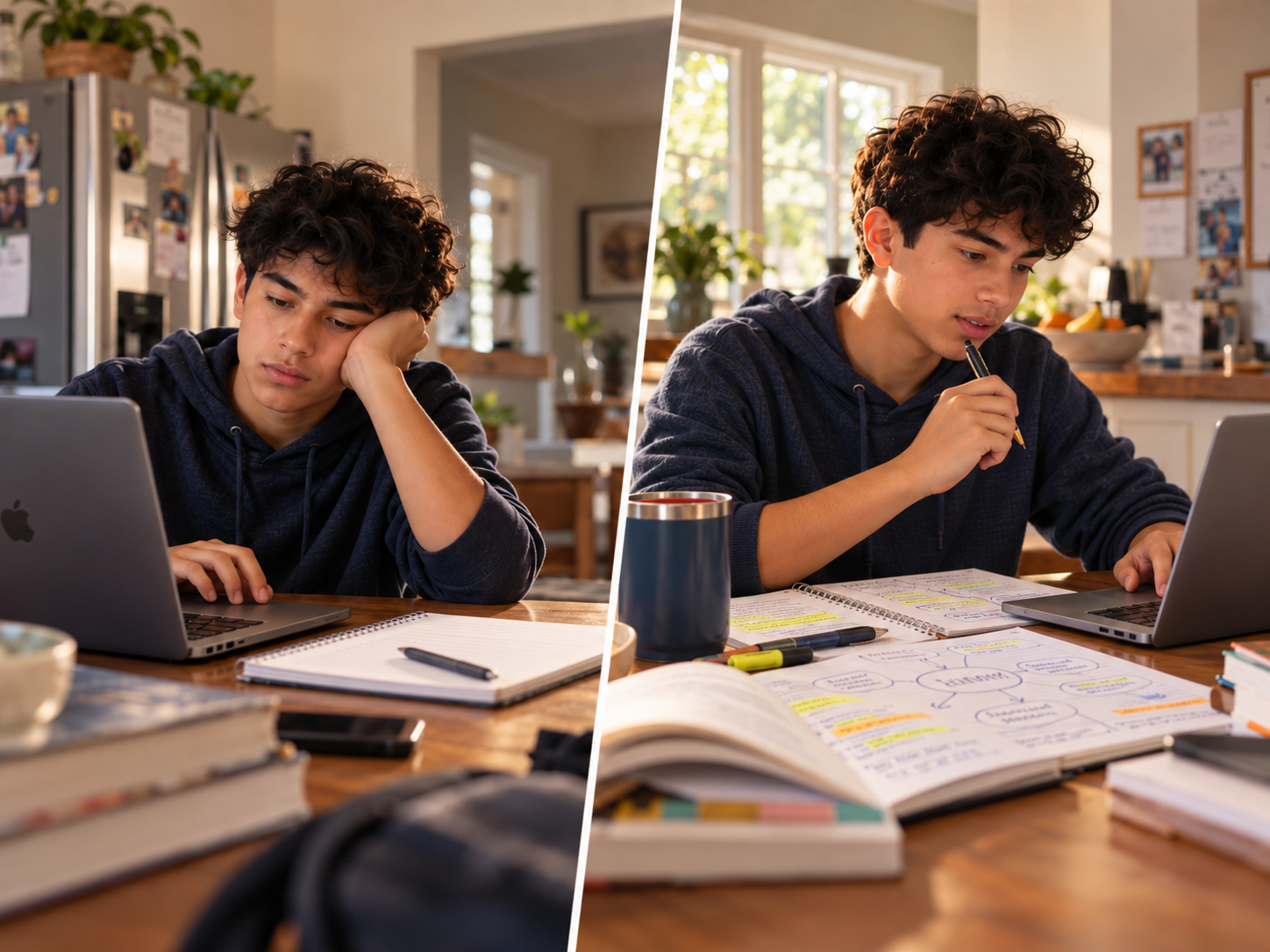
AI Didn't Create the Education Problem
ChatGPT was released to the public on November 30, 2022. That launch arguably kicked off the modern consumer AI era.
Our education problems did not begin on December 1.
The National Assessment of Educational Progress, often called America's Report Card, was showing serious warning signs years earlier. By 2020, average reading and math scores for 13-year-olds had already declined from 2012 levels, with some of the biggest losses among lower-performing students. In 2019, national reading scores for fourth and eighth graders had fallen from 2017, and lower-performing students had been losing ground over much of the previous decade. (National Center for Education Statistics)
And people had been arguing about the failure of our education systems for decades before that.
In 1983, the federal A Nation at Risk report warned about serious weaknesses in American education.
Then there was John Taylor Gatto, the award-winning New York teacher who published Dumbing Us Down in 1992. Gatto was a provocative critic of institutional schooling, not an education researcher delivering the final scientific verdict. But his complaints sound remarkably familiar today. He argued that too much schooling rewarded compliance while weakening curiosity, concentration, independence and genuine self-directed learning.
You don't have to agree with everything Gatto wrote to notice the timeline.
We were worrying about students losing curiosity thirty years before ChatGPT.
So when test scores fall over the next few years, I suspect AI is going to make a wonderfully convenient suspect.
It is new.
It is powerful.
It is poorly understood.
And blaming the new kid is always easier than examining the whole neighborhood.
We Have Already Lived Through One Technology Experiment
There is another piece of this story parents shouldn't ignore.
Before AI arrived, we put extraordinarily powerful smartphones into the pockets of millions of children and connected them to social-media systems designed to compete relentlessly for their attention.
Jonathan Haidt has become one of the most prominent voices arguing that the shift toward a phone-based childhood has contributed to serious problems in adolescent development and mental health. His interpretation is not uncontested. Researchers still debate the size of social media's effects and which young people are most vulnerable. A 2024 Nature Reviews Psychology article described the evidence as mixed, while also identifying several ways social media can interact with normal adolescent development to increase vulnerability. (Nature)
The U.S. Surgeon General went far enough in 2023 to say that we cannot conclude social media is sufficiently safe for children and adolescents.
That matters to the AI conversation.
Because smartphones teach us a lesson I hope we don't have to learn twice:
Giving young people powerful technology without teaching them how to use it wisely is not a strategy.
But neither is pretending the technology doesn't exist.
AI deserves guardrails.
It also deserves instruction.
The Most Interesting Question Isn't Whether Kids Use AI
A 2026 study by Cecilia Ka Yuk Chan gives us a much better way to think about this.
Chan studied 145 secondary students ages 14 to 17 and looked at how they described using AI while learning.
Students described AI helping them understand difficult concepts, catch mistakes, generate possibilities, organize information, receive personalized explanations and work through overwhelming assignments.
But they also recognized something important.
The exact same AI could either extend their thinking or replace it. (Scale Stanford)
That difference is huge.
A student can ask:
"Write my argument."
Or:
"Find the weaknesses in my argument."
They can ask:
"Solve this problem."
Or:
"Give me a hint and let me try again."
They can say:
"Give me a business idea."
Or:
"Here are three problems I've noticed. Help me explore which one might be worth solving."
Same laptop.
Same AI.
Completely different education.
At Waypoint, we've been calling that distinction:
AI as a coach versus AI as a crutch.
Chan's study gives us stronger language for what is happening underneath it.
When AI replaces the student's mental work, it becomes a substitute.
When AI helps the student reason, question, create, organize, practice or see something they couldn't see before, it becomes an extension of their ability.
That may be one of the most important AI literacy skills we can teach.

And... What If AI Is Also Part of the Solution?
Here is where the story gets even more interesting.
While some people are asking whether AI will destroy education, MacKenzie Price and Alpha School are experimenting with the opposite possibility.
Alpha School uses a personalized learning system they called 2 Hour Learning, now rebranded as TimeBack. Students spend roughly two hours each morning working through AI-powered personalized, mastery-based academics. Human "Guides" support motivation and progress, while much of the remaining school day is used for projects, life skills and interests.
Alpha reports striking results on nationally normed MAP assessments, including students learning substantially faster than national norms and many scoring at very high percentiles.
Now, I would put a healthy asterisk beside those numbers.
Most of the headline performance claims come from Alpha itself. Alpha is also a selective private-school environment, and outside critics have reasonably asked how much of the performance comes from the model versus the students and families attracted to it. We do not yet have enough independent evidence to declare that every school in America should copy Alpha tomorrow morning.
But we shouldn't dismiss what they are demonstrating either.
They are asking a fascinating question:
What if technology could make academics more personal and efficient, so young people had MORE time for relationships, creativity, physical activity, real-world projects and meaningful work?
That is a very different picture from teenagers sitting in front of ChatGPT for eight hours while robots slowly replace everybody they know.
In fact, Alpha's model deliberately pairs adaptive technology with human Guides and real-world experiences.
That should get our attention.

So What Should Parents Actually Do?
I wouldn't make "Did you use AI?" the main question at home.
Ask better questions:
What did you try before asking AI?
Did AI give you the answer, or help you understand the problem?
What did you disagree with or change?
Could you explain this without the AI sitting beside you?
What can you do now that you couldn't do before?
Those questions move us away from policing technology and toward developing judgment.
And judgment is what our kids are going to need.
AI Isn't Going Away. Neither Should Their Brains.
There are legitimate reasons to worry about AI in education.
A teenager who habitually outsources writing, reasoning, creativity and decision-making may become more dependent while appearing more capable.
We should take that risk seriously.
But blaming AI for every declining test score would be historically convenient and intellectually sloppy.
Our education problems are older than ChatGPT.
Our children's struggles with attention, motivation, mental health and technology are older than ChatGPT.
And perhaps, used differently, AI could become part of how we address some of them.
The question I want parents asking isn't:
"Will AI make my child smarter or dumber?"
AI isn't going to make that decision by itself.
The better question is:
"What kind of person is my child becoming while they use it?"
Are they becoming more curious?
More capable?
More creative?
More confident solving difficult problems?
More able to think independently?
Or are they slowly handing those responsibilities to a machine?
That distinction is why I don't want our kids running away from AI.
I want them learning how to use it without surrendering themselves to it.
AI should remove unnecessary friction, not the struggle that creates growth.
And it should always remain what we have been saying at Waypoint:
A coach, not a crutch.
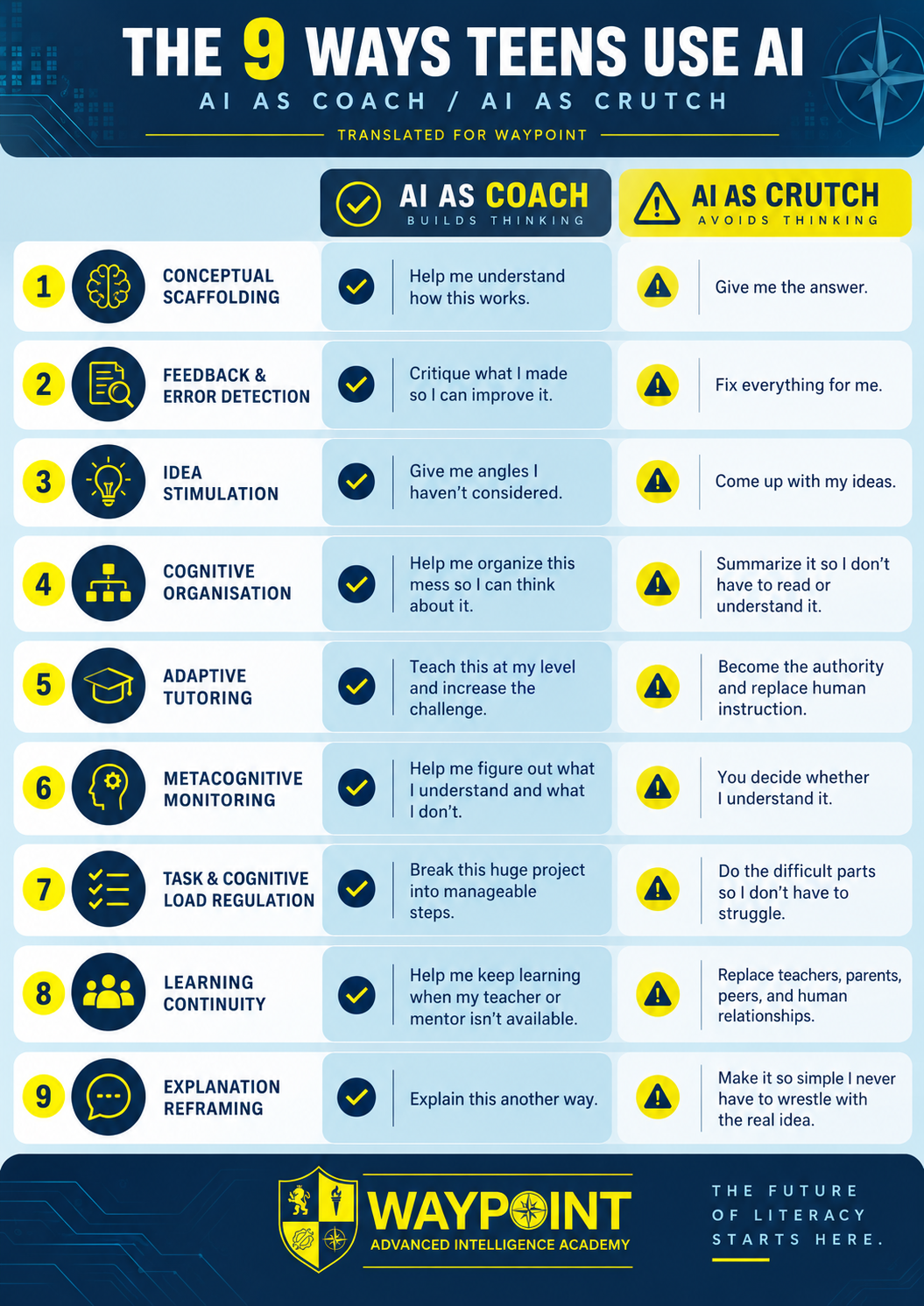
Waypoint helps families raise safe, capable, future-ready teens in the age of AI. Inside our AI Pathfinder Certificate, students learn how to use powerful AI wisely, honestly and creatively, while remaining responsible for the thinking, judgment and decisions that help them become more capable, not more dependent.