

"My Kids Don't Really Use AI Yet"
“If we don’t teach students to utilize AI, we aren’t preparing them for the world they’re stepping into. We’re preparing them for a world that no longer exists.” - Tim Mousel
Your Kids May Not Be Using AI Yet. That’s Exactly Why This Conversation Matters.
I spoke with hundreds of parents and teens at a recent conference of homeschooling families.
And honestly, I came home with a surprising realization.
Most homeschool moms are not yet to the point where they see a need for AI education for their kids.
Not because they are careless.
Not because they are lazy.
Not because they do not care about the future.
Actually, I think it is almost the opposite.
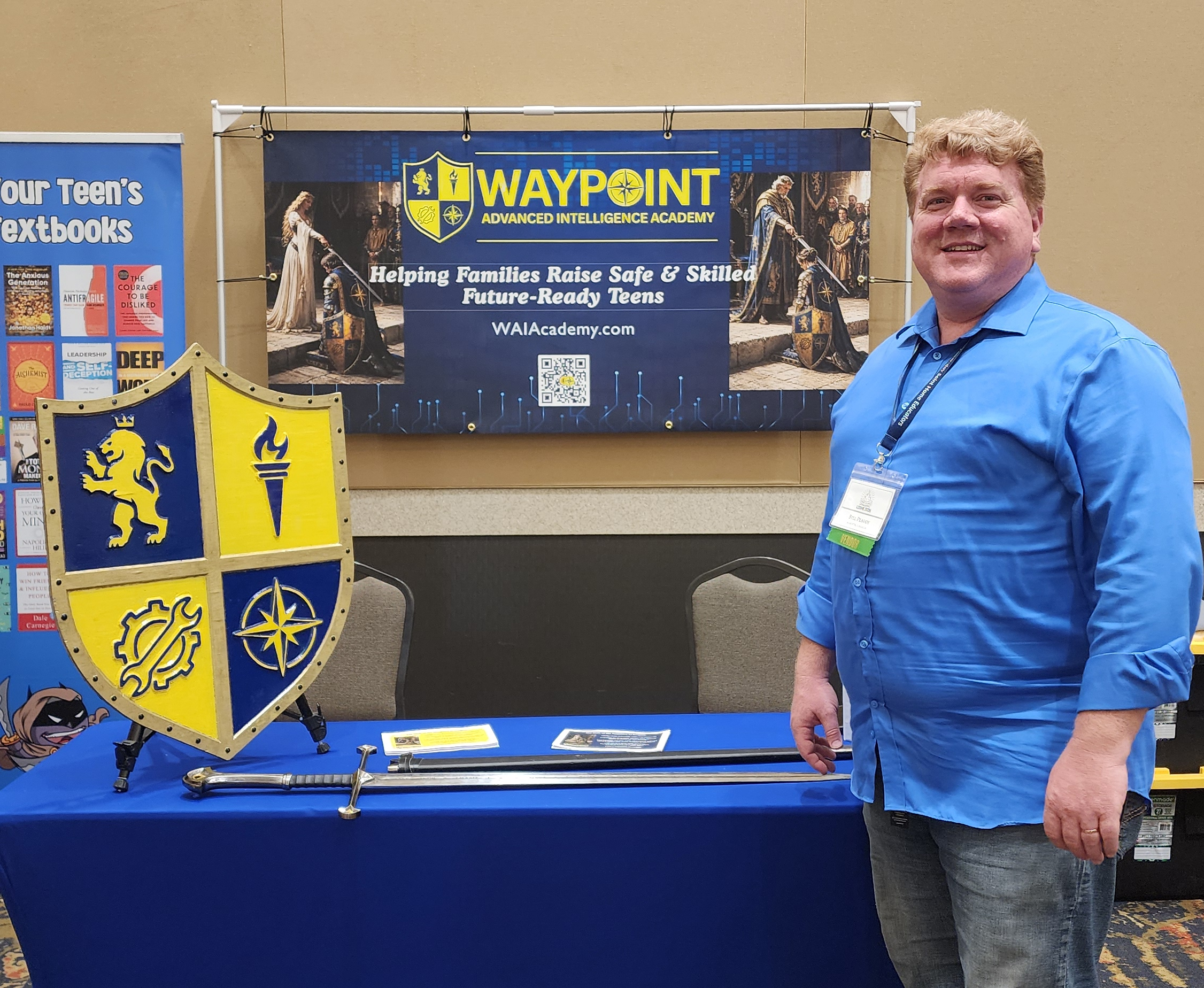
Most of the moms I talked to care very deeply about their children. They care about what their kids are learning. They care about character. They care about truth. They care about protecting their homes from harmful influences.
That is why many of them homeschool in the first place.
But when it comes to AI, many of them seem to have a simple plan:
Ignore it for now.
Maybe ban it.
Deal with it later.
When I asked about AI safety, I often got the same basic response:
“My kids don’t really use AI yet.”
And I get it.
If your child is not opening ChatGPT, asking a chatbot questions, or using AI to write school assignments, it can feel like AI is not really part of your home.
But I think that may be the first misunderstanding we need to gently clear up.
Because AI is not just ChatGPT, or Claude, or Gemini.
AI is deeply embedded in the recommendation systems, search tools, feeds, games, apps, and digital environments our kids are growing up around. It's algorithm is already shaping attention. It is already learning preferences. AI is already nudging behavior.
That does not mean we should panic.
But it does mean we should pay attention.
“My Kids Don’t Use AI” May Not Mean What We Think It Means
When a mom says, “My kids don’t use AI,” she usually means something very specific.
She means her child is not intentionally sitting down to use a chatbot.
That may be true.
But that does not mean her child is growing up outside the influence of AI-shaped systems.
Our kids may not be “using AI” in the way adults usually picture it.
But AI-shaped systems are already learning them.
Their attention.
Their interests.
Their habits.
Their weaknesses.
Their patterns.
Their clicks.
Their curiosity.
And soon, generative AI will become even more personal. It will not just recommend the next video. It will answer questions, help with homework, generate images, write essays, give advice, imitate friendship, and make shortcuts feel completely normal.
That is why this matters.
Not because every child needs to become obsessed with AI.
Not because every parent needs to become a tech expert.
But because every family needs wisdom for an AI-shaped world.
I Understand Why Some Parents Want to Ban AI
A lot of parents have good reasons to be cautious.
AI can be used to cheat.
AI can replace effort.
AI can produce false information confidently.
AI can blur the line between original work and copied work.
AI can become emotionally unhealthy if a child starts treating it like a friend, therapist, parent, or source of identity.
AI can be used by powerful people for selfish purposes.
AI can make a child faster without making them wiser.
So I understand the instinct to say, “Nope. Not in my house.”
In fact, I think that protective instinct is good.
But here is the concern:
A ban may delay exposure, but it doesn't help build discernment.
At some point, our kids will encounter AI outside our homes. They will encounter it through friends, schoolwork, jobs, college, business tools, search engines, apps, creative platforms, and future workplaces.
The question is not simply, “Can I keep my child away from AI today?”
The deeper question is:
“What kind of wisdom will my child need when AI becomes impossible to ignore?”
That is the conversation I believe families need to be having now.
The Things Moms Already Care About
Most moms do not care yet about “AI literacy.”
That phrase sounds technical.
It sounds optional.
It sounds like one more thing on the already impossible homeschool checklist.
But moms absolutely care about the things AI is going to affect.
They care about motivation.
They care about honesty.
They care about confidence.
They care about screen time.
They care about truth.
They care about emotional health.
They care about future readiness.
They care about whether their children grow into capable, grounded, faithful, self-directed adults.
And that is exactly why AI belongs on the parenting radar.
Not because AI is the goal, but because wisdom is the goal.
AI is just the new arena where wisdom has to be taught.

Motivation: Will AI Build Momentum or Replace Effort?
A lot of parents are already worried their teens are unmotivated.
They see kids who are bright but passive.
Kids who have interests but no follow-through.
Kids who can consume for hours but struggle to start something meaningful.
AI can make that better or worse.
Used poorly, AI becomes a shortcut machine. It can help a teen avoid the very effort that builds discipline, confidence, and identity.
But used wisely, AI can become a coach.
It can help a teen turn an interest into a project.
It can help them break a big goal into steps.
It can help them practice, plan, revise, and improve.
It can help them move from “I don’t know what to do” to “I can take the next step.”
That is the difference between using AI as a crutch and partnering with AI as a coach.
The goal is not to make life easier in every possible way.
Sometimes the hard part is the part that matters.
The goal is to help teens use AI to become more capable, not more dependent.
Honesty: AI Makes Cheating Easier, So Integrity Has to Get Stronger
One of the biggest concerns parents have is cheating.
And they should.
AI makes it easier than ever for a student to produce work they did not really do.
But here is the problem:
If the only thing we teach our kids is “Do not use AI,” we may not be preparing them for the real ethical decisions they will face.
They need to know the difference between getting help and pretending.
Using AI to explain a concept is different from having AI do the assignment.
Using AI to brainstorm is different from submitting AI-generated work as your own.
Using AI to practice is different from outsourcing the struggle.
This is not just an academic issue.
It is a character issue.
AI does not create dishonesty in a child’s heart, but it can make dishonesty easier, faster, and harder to detect.
That means integrity has to become stronger.
The first AI lesson should not be prompting.
It should be honesty.
Confidence: If AI Does the Hard Part, Kids Lose the Proof That They Can
Many parents are worried about confidence.
Not fake confidence.
Real confidence.
The kind that comes when a child does something hard and realizes, “I can actually do this.”
That kind of confidence is built through effort.
Through practice.
Through struggle.
Through trying again.
Through making mistakes and improving.
But if AI always does the hard part, kids may lose the proof that they can do hard things themselves.
That is one of the biggest hidden risks.
A teen may feel productive while becoming less capable.
They may finish more assignments while gaining less confidence.
They may create more output while building less ownership.
That is why wise AI training matters.
AI should not remove every struggle.
It should help teens face better struggles.
It should help them think more clearly, ask better questions, practice harder skills, and create something they could not have created alone.
Used well, AI can build confidence.
Used poorly, it can quietly erode it.

Truth: Fast Answers Are Not the Same as True Answers
Parents are already worried about misinformation, propaganda, online confusion, and kids believing things too easily.
AI adds a new layer.
A chatbot can sound calm, confident, and polished even when it is wrong.
That means our kids need to become better truth-checkers, not just faster answer-getters.
In the AI age, the smartest kids will not be the ones who get answers fastest.
They will be the ones who can tell which answers are true.
They need to learn how to ask:
Where did this information come from?
Can I verify it?
What is missing?
What assumptions are being made?
Does this align with what I already know to be true?
Could this answer be incomplete, biased, or simply wrong?
That is not just AI literacy.
That is wisdom.
Screen Time: The Next Battle May Not Be About Time
For years, parents have worried about screen time.
How much is too much?
What should be allowed?
What should be blocked?
How do we stop screens from taking over the home?
Those questions still matter.
But AI changes the conversation.
The next screen-time battle may not just be about time.
It may be about purpose.
A teen spending an hour using a screen to build a business plan, practice a skill, study a hard topic, create a short film, or solve a real problem is not doing the same thing as a teen spending an hour in endless entertainment loops.
The question is not only, “How long were you on the screen?”
The better question is:
“What was the screen training you to become?”
Was it training passivity or creativity?
Dependency or capability?
Distraction or direction?
Shortcut thinking or deeper thinking?
AI can become just another form of digital noise.
Or it can become a tool for purposeful creation.
The difference is training.
Emotional Health: AI Should Never Become a Child’s Best Friend
This one matters deeply.
AI tools are becoming more conversational, more personal, and more emotionally responsive.
Some teens may begin using AI for advice, comfort, casual conversation, or emotional support.
That does not automatically mean something terrible is happening.
But it does mean families need clear boundaries.
AI should never become a child’s best friend.
It should not replace parents.
It should not replace mentors.
It should not replace real friendships.
It should not replace spiritual guidance.
It should not become a child’s source of identity.
A wise child needs to understand what AI is and what it is not.
AI can be a tool.
It can be useful.
It can even be helpful in certain moments.
But it cannot love your child.
It cannot know your child the way a parent, mentor, sibling, or true friend can.
It cannot replace real human connection.
That is a lesson we should teach before a lonely teen starts learning it the hard way.

Future Readiness: The World Is Not Waiting for Parents to Feel Ready
Another reason this matters is simple:
The world is moving.
AI is already entering workplaces, businesses, creative fields, education, communication, and problem-solving.
We may not know exactly what the job market will look like ten years from now.
But we can see the direction.
The future will reward people who can think clearly, learn quickly, use powerful tools responsibly, solve real problems, and adapt without losing their values.
That does not mean every teen needs to become a programmer.
It does not mean every child needs to spend their life staring at screens.
It does mean our children need to become the kind of people who can handle powerful tools with wisdom.
They need human skills.
They need moral judgment.
They need creativity.
They need communication.
They need self-control.
They need truthfulness.
They need the ability to learn new tools without being ruled by them.
That is future readiness.
Not just technical skill.
Character plus capability.
The Real Goal
The goal is not to raise AI kids.
The goal is to raise wise kids.
Kids who can use powerful tools without being used by them.
Kids who can partner with AI without becoming dependent on it.
Kids who can protect their attention, tell the truth, build real skills, and use technology for good.
That is why I believe AI belongs on the parenting radar now.
Not because every child is already using ChatGPT.
Not because AI is perfectly safe.
Not because we should trust every new tool.
But because the things we already care about as parents are being touched by AI.
Motivation.
Honesty.
Confidence.
Truth.
Emotional health.
Future readiness.
Purpose.
Character.
AI is the new arena.
At Waypoint, our mission is to help families prepare for that arena with calm, clarity, and purpose.
We are not pro-AI.
We are pro-wise kids.
And in a world full of powerful tools, wise kids will need more than avoidance.
They will need guidance.
They will need standards.
They will need practice.
They will need parents willing to lead before the world leads for them.