

We Were Not Prepared for AI in Our Homes
“If we don’t teach students to utilize AI, we aren’t preparing them for the world they’re stepping into. We’re preparing them for a world that no longer exists.” - Tim Mousel
No parent was trained for this.
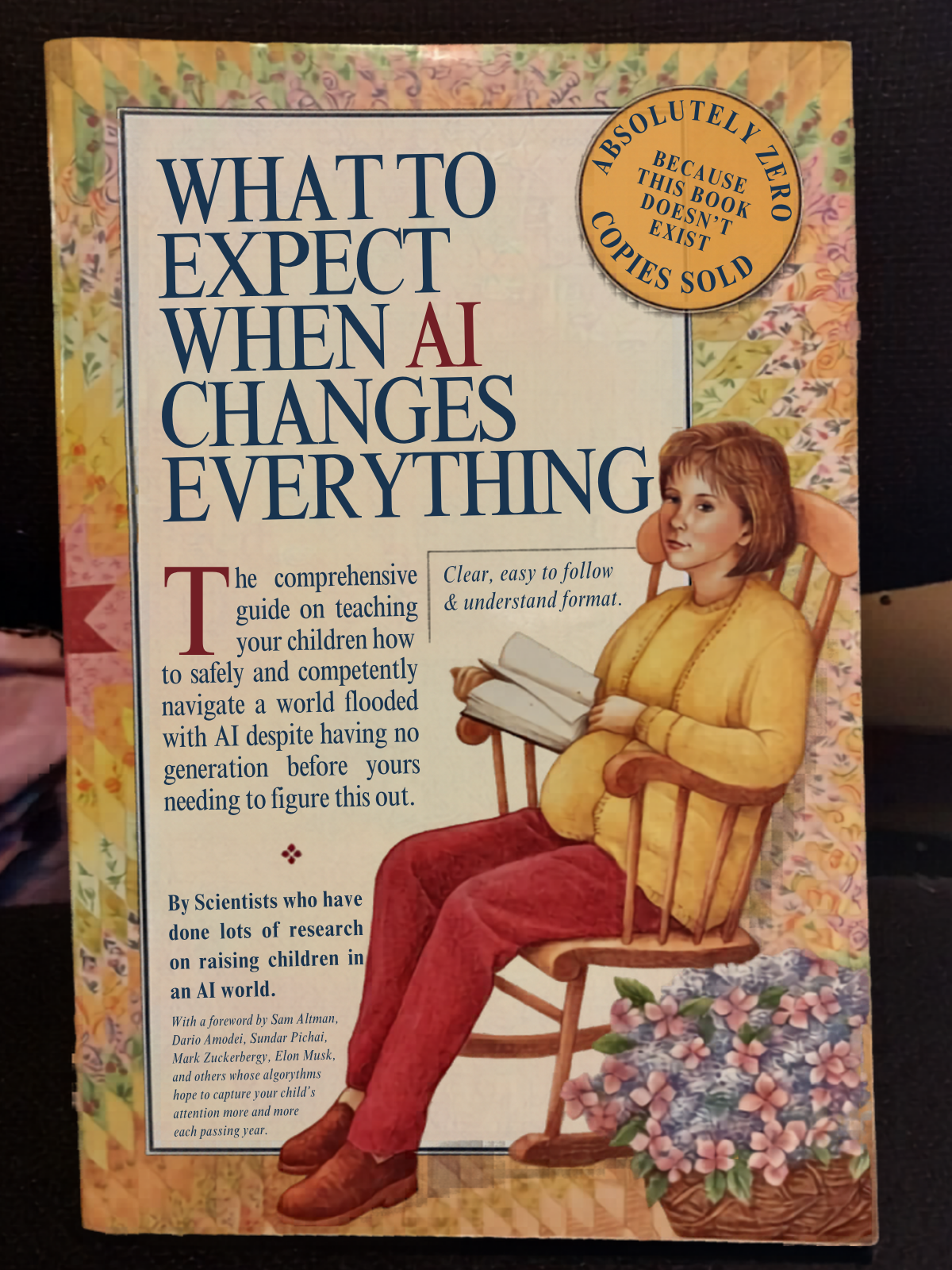
We were not handed a manual at the hospital that said, “Congratulations on your baby. Also, in about twelve years, your child may have access to a machine that can write essays, generate images, answer personal questions, imitate human conversation, summarize books, solve homework, create videos, and confidently make things up.”
No parent I know got that book.
So if you feel behind, overwhelmed, suspicious, curious, cautious, or completely unsure what rules to set around AI in your home, take a breath.
You are not failing.
You are parenting during the largest technology shift that arrived faster than the culture could explain it. We are all pioneers on this frontier together. And these are uncharted waters.
Parents are being asked to lead something they were never taught
A lot of parents feel embarrassed that they do not understand AI better.
They hear other people talking about Chatbots, AI tutors, AI art, AI homework, AI safety, AI companions, AI careers, and AI tools, and suddenly it feels like everyone else got the parent handbook except them.
They did not.
Most parents are figuring this out in real time.
And that matters because AI is not entering our homes slowly. It is not politely waiting at the front door until every family has had time to create a thoughtful policy.
It is showing up in search engines.
It is showing up in school assignments.
It is showing up in phones.
It is showing up in writing tools.
It is showing up in apps teens already use.
It is showing up in conversations between kids.
A parent may think, “We do not use AI in our house,” while their child is already seeing AI answers at the top of search results or hearing classmates talk about using it for homework.
That does not mean parents need to panic.
It does mean we need to wake up.
Social media should have taught us something
Jonathan Haidt's recent bestseller, Anxious Generation, alerted us to some powerful points about social media and childhood: families were handed a massive social experiment before we really understood what it would do to kids.
Parents were told these tools were fun, useful, connecting, and basically inevitable.
Then years later, many families looked around and thought, “Wait. What happened to childhood?”
The hard truth is that much of the research, wisdom, and public concern came after the technology was already deeply embedded in the lives of young people.
AI may be moving even faster.
We do not yet know all the long-term effects of growing up with generative AI. We do not fully know what happens when young brains learn to rely on instant answers, conversational machines, synthetic media, and tools that can do large parts of schoolwork, writing, creativity, and decision-making.
That kind of research will remain incomplete for the next 20 years. And in 20 years that research will likely already be obsolete for whatever amazing technology breakthroughs are happening in the 2040s.
So parenting cannot wait for perfect research.
Our children are growing up right now.
“We don’t know yet” is not the same as “do nothing”
One of the most difficult things about parenting in the AI age is uncertainty.
We do not know everything AI will become.
We do not know every risk.
We do not know every benefit.
We do not know exactly how schools will adapt.
We do not know how employers will expect young adults to use AI ten years from now (rest assured they will expect something).
We do not know how long-term AI use will affect attention, writing, creativity, motivation, emotional development, or critical thinking.
That uncertainty can tempt parents in two opposite directions.
Some parents say, “Since we don’t know, I’ll keep my child away from it completely.”
Other parents say, “Since it’s the future, I’ll let my child use it freely.”
Both responses are understandable.
Neither is enough.
When we do not know everything, wisdom does not mean pretending we know. Wisdom means moving carefully, paying attention, setting boundaries, learning alongside our children, and refusing to outsource our parental responsibility to schools, tech companies, or whatever app happens to be trending this week.
Sweeping AI under the rug is not wisdom.
Handing it over casually is not wisdom either.
The wiser path is guided preparation.
Why this feels harder than other technology
Parents have dealt with new technology before.
Television. Video games. Smartphones. Social media. YouTube. TikTok. Messaging apps. Online gaming.
Each one brought challenges.
But AI is different in a few important ways.
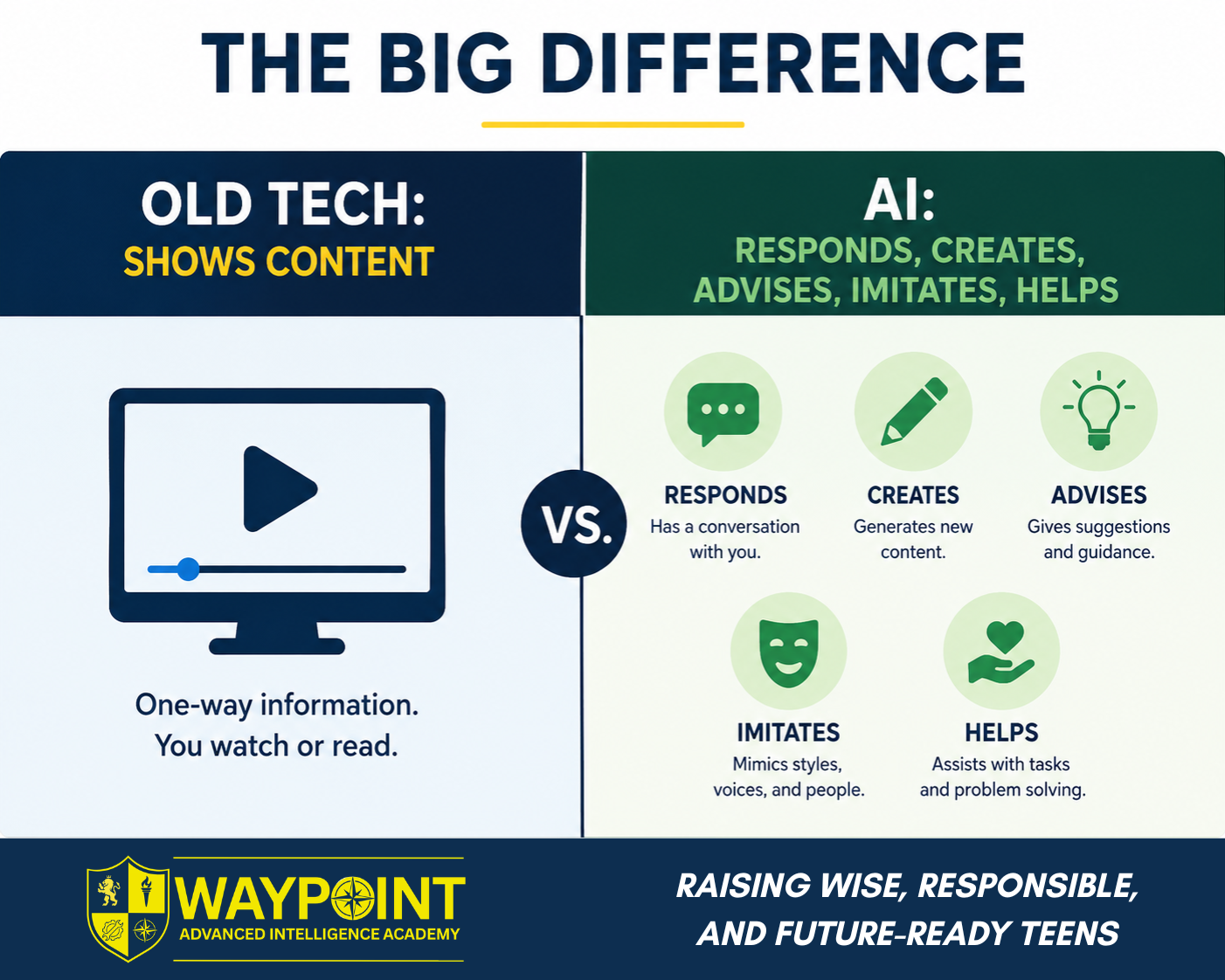
AI does not just show content. It responds.
AI does not just entertain. It produces.
AI does not just distract. It can imitate help.
AI does not just give information. It can shape thinking.
AI does not just connect teens to others. It can feel like the “other.”
That is why parents can feel so unsettled.
AI can be a tutor, writing assistant, brainstorming partner, image generator, coding helper, study coach, search tool, and conversation partner.
That range is part of what makes it powerful.
It is also what makes it complicated.
A calculator solves a math problem.
AI can help a teen avoid developing the thinking required to understand the problem in the first place.
A search engine points to websites.
AI can summarize, interpret, recommend, and answer in a voice that sounds confident, even when it is incomplete or wrong.
A social media feed shows content.
AI can engage a teen in a private conversation that feels personal.
So no, you are not overreacting if AI feels different.
It is different.
Parents do not need to become AI experts overnight
Here is the good news.
You do not need to understand every AI model, tool, update, company, platform, and setting before you can lead your family.
You do not need to become a Silicon Valley engineer in a cardigan.
You do need to understand enough to ask better questions and set better boundaries.
Start with simple questions:
What AI tools is my teen already using or seeing?
Does their school allow AI for assignments?
Does my teen know the difference between AI help and AI cheating?
Does my teen understand that AI can be wrong?
Does my teen know not to share private information?
Does my teen treat AI like a tool or like a person?
Do we have clear family rules for AI use?
Have we talked about when AI should not be used?
Those questions are enough to begin.
Parents often feel like they need perfect knowledge before they act.
You do not.
You need humble leadership.
That means being willing to say:
“I’m learning this too, but we are not going to ignore it.”
That sentence may be one of the most powerful things a parent can say right now.
The goal is not fear. The goal is family leadership.
Fear alone does not prepare children.
But neither does silence.
The goal is not to make AI the new family monster hiding under the bed. The goal is to help your teen develop judgment.
That means talking openly about both sides.
AI can help teens learn, create, practice, organize, and build real skills.
AI can also help teens cheat, avoid effort, trust bad information, share private details, lose confidence in their own thinking, or become emotionally confused by tools that imitate human connection.
Both things are true.
Your teen needs to hear both.
Not in a panicked lecture.
Not in a tech-hype sales pitch.
In a calm, honest family conversation.
Something like:
“AI is going to be part of your world. Some of it may be very useful. Some of it may be harmful. Our job is to learn how to use it with wisdom, honesty, and self-control.”
That is not fear.
That is leadership.
A simple starting point for families
When something feels overwhelming, parents need a first step.
Not a giant family constitution. Not a three-hour lecture.
Start smaller.
Try this family conversation:
1. Ask what your teen already knows about AI.
Let them talk first. You may be surprised by what they know, and what they misunderstand.
2. Ask where they have already seen AI.
School, search, apps, friends, YouTube, games, writing tools.
3. Talk about the difference between help and replacement.
AI may help explain, quiz, brainstorm, or give feedback. It should not do their thinking, writing, or decision-making for them.
4. Set one privacy rule.
If you would not want it saved, screenshotted, or repeated, do not type it into AI.
5. Set one schoolwork rule.
Think first. Try first. Use AI second. Never turn in work you cannot explain.
6. Set one relationship rule.
AI is a tool, not a friend, counselor, parent, or replacement for real people.
That is a strong beginning.
Not perfect.
But strong.

We must prepare them while they are still in our care
This is the heart of the issue.
Our children will not stay children forever.
At some point, they will have more freedom, more devices, more school expectations, more work demands, more social pressure, and more access to tools we may not be standing there to supervise.
That means the years inside our homes matter deeply.
This is where they should learn:
How to pause.
How to question.
How to verify.
How to protect privacy.
How to use tools honestly.
How to think before asking AI.
How to value real relationships.
How to create instead of only consume.
How to keep their own mind active and strong.
If we wait until they are on their own, we may miss the best window for training.
Not because we need to rush them.
Because we need to guide them before the world does.
A final word to the overwhelmed parent
You were not prepared for this.
Most of us were not.
But that does not mean you are powerless.
Parents have always had to raise children in a world they did not fully control. This moment is new, but the deeper calling is not.
We teach wisdom before independence.
We teach honesty before opportunity.
We teach discernment before danger.
We teach courage before the child leaves our side.
AI may be new, but parenting has always required us to face unknowns with love, humility, and backbone.
So no, you do not need to know everything today.
But you do need to begin.
Do not sweep AI under the rug.
Do not hand it over without guidance.
Start the conversation. Set the first boundary. Learn one tool. Ask one better question. Create one family rule.
Your child does not need a perfect AI expert.
They need a parent who is willing to lead, "for such a time as this."
Want help navigating AI at home?
Waypoint helps families raise safe, capable, future-ready teens in the age of AI. Inside our Future-Ready Families Certificate, parents learn how to guide AI wisely and with confidence.
A good first step is to join our free parent community, Parenting in the AI Age, where we help parents navigate AI safety, teen tech habits, school concerns, homework, and future-ready skills with clarity instead of panic.