

Recursive Self-Improvement: The Human Skill our Teens Need in the Age of AI
“As we marvel at the possibility of recursive self-improvement in machines, we seem to have lost sight of the recursive self-improvement that’s built into our humanity—our fundamental drive to grow, improve, and evolve.” - Arianna Huffington
There is a phrase showing up more and more in conversations about advanced AI:
Recursive Self-Improvement
It sounds like something that belongs in a research lab, next to a whiteboard full of equations and one very tired engineer holding a questionable energy drink.
In AI terms, recursive self-improvement means a system becomes capable of improving itself, then improving the process by which it improves itself. Anthropic recently described this as a future where AI systems could eventually help design and develop their own successors. They were careful to say we are not there yet, and that this future is not guaranteed, but they also warned it could arrive sooner than many institutions are prepared for.
That is a serious conversation.
But before parents get lost in the technical implications, there is something deeper worth noticing.

Recursive self-improvement was a human idea long before it was an AI concern.
A recent TIME essay by Arianna Huffington made this point well. Ordinary improvement is when someone practices and gets a little better. Recursive self-improvement is different. Each improvement makes the next improvement easier. The person does not just get better at the task. They get better at getting better.
That idea matters deeply for our teens.
Because the real question is not just whether AI will learn to improve itself.
The question is whether our children will.
The older meaning of self-improvement
Every parent has seen this in real life.
A teen learns how to manage frustration, so the next hard assignment does not feel quite as impossible.
A child learns how to plan a project, so the next project starts with less chaos.
A young person learns how to apologize sincerely, so the next conflict does not turn into World War III in the living room.
That is recursive self-improvement.
One layer of growth makes the next layer possible.
A teen who learns focus can now learn discipline.
A teen who learns discipline can now build confidence.
A teen who builds confidence can now take on harder challenges.
A teen who takes on harder challenges starts to see themselves differently.
That last part is the gold.
Because the most important thing a young person builds is not the essay, the project, the business idea, the video, the app, or the portfolio.
They are building the kind of person who can build those things.

Why this matters more in the AI age
AI changes the environment our kids are growing up in.
According to Pew Research Center, 54% of U.S. teens have used AI tools for help with schoolwork, and one in ten say AI helps with all or most of their schoolwork. Pew also found that 59% of teens say students at their school use AI to cheat at least somewhat often.
That does not mean AI is inherently bad.
It means AI is already here.
And when a powerful tool becomes normal, the old parenting question changes.
It is no longer only, “Is my teen using AI?”
A better question is, “What kind of person is my teen becoming while using AI?”
That question matters, because AI can help a teen improve recursively, or it can quietly interrupt the process.
Used well, AI can help a teen reflect, revise, practice, plan, compare, question, test, and build. It can become a coach that strengthens the very skills parents want their children to develop.
Used poorly, AI can remove the productive struggle where growth happens. It can give the answer before the teen has formed the question. It can polish the essay before the student has wrestled with the thought. It can make effort feel optional.
And effort is not just how kids get work done.
Effort is where identity is built.
The danger of becoming “assisted” instead of capable
Moms can usually sense when something is off.
A teen may still be getting assignments done, but the confidence is not growing.
The work looks polished, but the thinking feels thinner.
The child seems productive, but also more dependent.
That is one of the quiet risks of AI.
Not that it instantly ruins kids.
Not that every use is cheating.
The more subtle concern is that a teen can start outsourcing the very muscles they most need to strengthen.
The muscle of attention.
The muscle of judgment.
The muscle of patience.
The muscle of truth-checking.
The muscle of emotional regulation.
The muscle of doing hard things without collapsing into “I can’t.”
This is where parents need a better framework than fear.
Banning AI completely may feel clean, but it often leaves teens unprepared. Unlimited AI use may feel modern, but it often leaves teens unguided.
The wiser path is guided use.
A future-ready teen should learn how to use AI in ways that increase capability, not dependency.

AI should help teens improve the loop
Here is a simple way to think about it.
Every teen already has loops running in their life.
Some loops are healthy:
Try → reflect → adjust → try again.
Feel frustrated → pause → name the emotion → choose a better response.
Write something messy → revise → clarify → communicate better.
Make a mistake → take responsibility → repair → grow.
Some loops are unhealthy:
Feel bored → grab phone → scroll → feel worse.
Feel stressed → avoid work → fall behind → feel more stressed.
Feel insecure → compare online → feel smaller.
Feel stuck → ask AI for the answer → avoid thinking → become less confident next time.
AI will not create a teen’s inner loops from nothing.
It will amplify the loops that are already forming.
This is why character still matters. Direction still matters. Family culture still matters.
AI is powerful, but it does not know who your child is meant to become. It does not love your child. It does not carry a parent’s stewardship. It cannot replace a mother’s discernment, a father’s guidance, or a family’s values.
It can support growth.
It can accelerate learning.
It can help a teen practice, prepare, organize, and create.
But it should never become the source of identity.
A better question for parents
Instead of asking, “Should my teen use AI?” try asking:
Is this use helping my teen become more capable after the tool is turned off?
That one question clarifies a lot.
If AI helps your teen understand a math concept well enough to solve the next problem alone, that is a good sign.
If AI helps your teen brainstorm ideas, then your teen chooses, edits, improves, and owns the final work, that is healthy.
If AI helps your teen practice an interview, prepare a presentation, study scripture, plan a service project, organize a business idea, or build something useful, you may be watching a powerful tool used in the right direction.
But if AI becomes the first stop for every hard thought, every emotional struggle, every assignment, every friendship question, and every uncomfortable decision, that is not growth.
That is drift.
And drift is sneaky.
It rarely announces itself with a villain laugh and a black cape. It usually shows up as convenience.
“Just this once.”
“I’ll think through it next time.”
“I already know this anyway.”
“It’s not a big deal.”
And suddenly the teen is not practicing the work of becoming.
They are practicing the habit of bypassing.

Three ways to build human recursive self-improvement
Parents do not need a computer science degree to lead here.
They need a few clear family practices.
1. Teach the “before AI, during AI, after AI” rule
Before using AI, your teen should make an honest attempt.
They should define the problem, write their first thoughts, or try the first step.
During AI use, they should ask for coaching, not replacement.
After AI use, they should explain what changed in their own understanding.
That final step matters most.
If your teen cannot explain what they learned, AI may have completed the task without strengthening the student.
2. Make reflection normal
A simple weekly question can do more than another lecture.
“What is one thing you got better at this week?”
Then follow it with:
“What helped you get better?”
That second question teaches your teen to notice the process behind growth.
Over time, they begin improving the way they improve.
That is the human version of recursive self-improvement.
3. Aim AI at becoming, not escaping
AI should not be used only to finish things faster.
Speed is useful, but speed without direction turns into noise with a Wi-Fi connection.
Encourage your teen to use AI for questions like:
“How can I practice this skill?”
“What are three ways I could improve this?”
“What assumption am I making?”
“What would a wise mentor ask me right now?”
“How can I make this more honest, useful, or clear?”
Those questions keep the teen in charge.
They also teach AI to serve the child’s growth instead of replacing it.
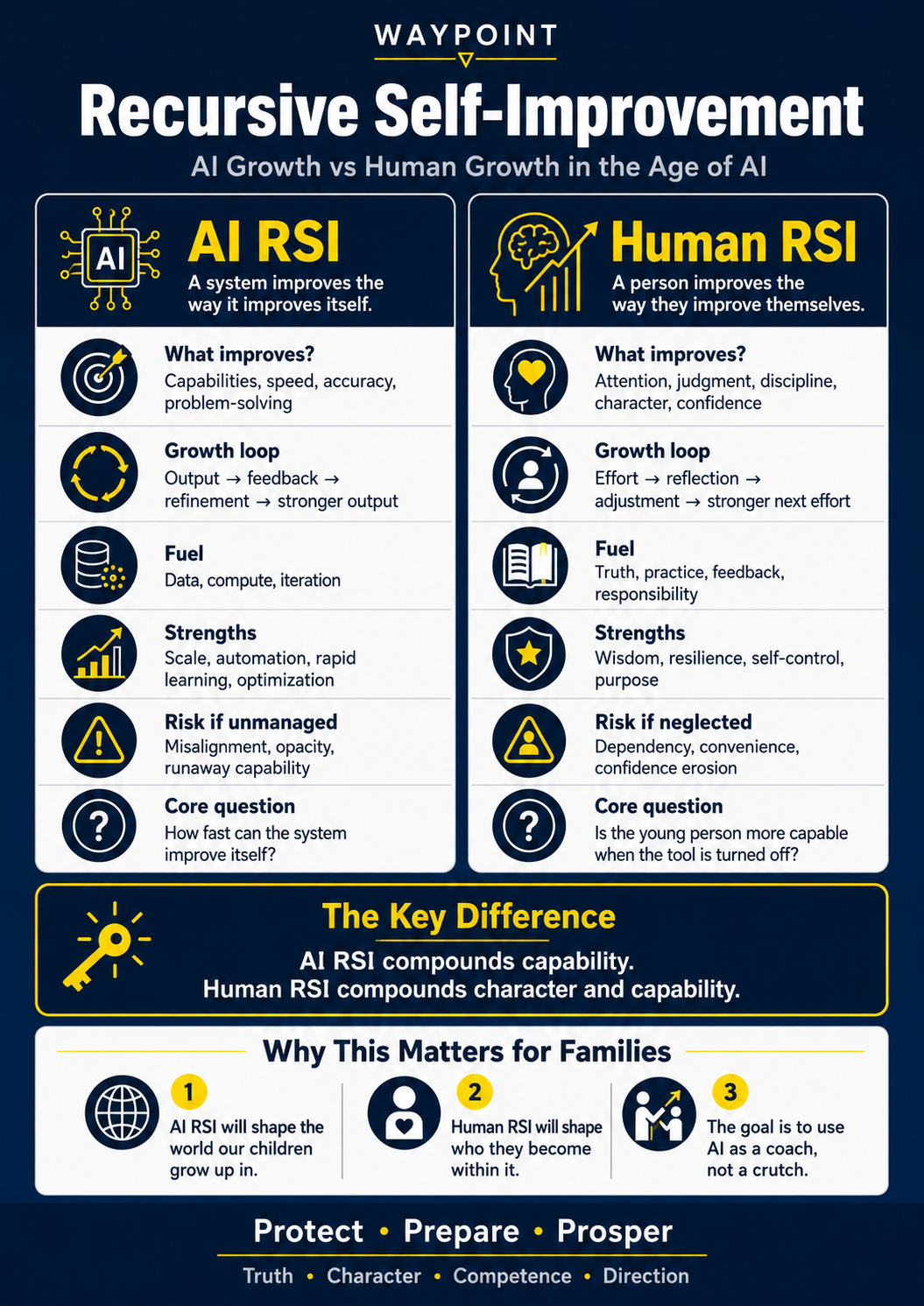
The future belongs to teens who can improve themselves
There is a reason recursive self-improvement feels so important in the AI conversation.
Compounding improvement changes everything.
Small gains do not stay small when they make future gains easier.
That is true for machines.
It is even more true for young people.
A teen who learns how to reflect becomes more teachable.
A teen who becomes more teachable grows faster.
A teen who grows faster builds confidence.
A teen with confidence takes on meaningful work.
A teen doing meaningful work starts to see a future worth preparing for.
That is the loop parents should want.
Not just higher productivity.
Not just better grades.
Not just a polished assignment that sounds suspiciously like a committee of consultants wrote it.
A stronger human being.
More honest.
More capable.
More disciplined.
More creative.
More useful.
More prepared to live, love, and serve in meaningful ways.
AI may become one of the most powerful tools ever created.
But its highest purpose in a family is not to make childhood easier.
Its highest purpose is to help our children become wiser, stronger, and more fully human.
And that kind of recursive self-improvement still begins at home.