
With the Iceberg Ahead the Education System is Turning Too Slowly: Your Family Doesn't Have To
“The primary goal of real education is not to deliver facts but to guide students to the truths that will allow them to take responsibility for their lives.”
- John Taylor Gatto
The question every parent and teacher hears from their teens at some point...
“Why do I need to learn this?”
Sometimes it comes with an eye roll.
Sometimes it comes at the kitchen table, halfway through a math assignment, when your child is frustrated and you are trying very hard not to become the villain in their origin story.
And sometimes, if we are honest, the question lands because a small part of us wonders the same thing.
Not because learning does not matter. It matters deeply.
But because the world our kids are entering is changing faster than the education system built to prepare them.
That does not mean school is useless. It does not mean every traditional subject should be thrown overboard while we all sprint into the future wearing VR goggles.
But it does mean thoughtful parents need to start asking better questions.
Not just, “Is my child getting good grades?”
But:
“Is my child becoming capable?”
“Is my child learning how to think?”
“Is my child prepared for a world where AI will be part of nearly every career, business, classroom, and creative field?”
“Is my child being trained for the future, or merely processed through the past?”
Those are not extreme questions anymore. They are responsible ones.
China Just Sent a Signal
Recently, China reportedly cut or suspended more than 12,000 university degree programs it considered outdated, while adding more than 10,000 new ones.
That is not a small curriculum update.
That is a national signal.
China is trying to reorient parts of its education system toward fields it believes will define the future: artificial intelligence, robotics, semiconductors, advanced manufacturing, digital technology, big data, and other high-demand industries.
Now, we do not need to agree with everything China does. We certainly do not need to copy their model of education or government planning.
But we should be wise enough to notice the signal.
China is looking at the next 20 years and saying, “The old map is not enough.”
Meanwhile, many parents in America are still being told that everything is basically fine. Keep the schedule. Finish the worksheet. Take the test. Get the credit. Hope the diploma still means what it used to mean.
But, more and more, parents can feel the gap.
And so can students.
Students Are Not Wrong to Want Relevance
When a teen asks, “When am I ever going to use this?” we often treat it like laziness.
Sometimes it is. I mean, let’s be honest, teenagers are wonderful, but they are also world-class negotiators when chores or algebra are involved.
But sometimes that question is not laziness.
Sometimes it is discernment.
Modern students live in a world where they can watch someone build an app, start a business, design a product, publish a book, create a film, launch a podcast, or learn a skill from anywhere on earth.
Then they go to school and are handed assignments that feel disconnected from real life.
They are not always rejecting learning. Often, they are rejecting irrelevance.
They want to know:
Why does this matter?
How does this connect to my future?
What can I actually do with this?
Is this helping me become more capable?
Is this preparing me for the real world?
Those are not bad questions.
In fact, those may be the exact questions more students should be asking.
The problem is not that teens want education to feel useful. The problem is that many adults have gotten used to defending an outdated system instead of redesigning a better one.
The Titanic and the Jet Skis
One reason the current education system struggles to "keep up" is not because of the teachers.
Many teachers see the iceberg clearly. They care deeply about students and would love to teach in a more practical, creative, future-ready ways.
The problem is that the public education system was not designed to turn quickly.
It is massive. It is layered with bureaucracy, standardized testing, district policies, state requirements, curriculum committees, political fights, budget limitations, and institutional habits that have been forming for decades.
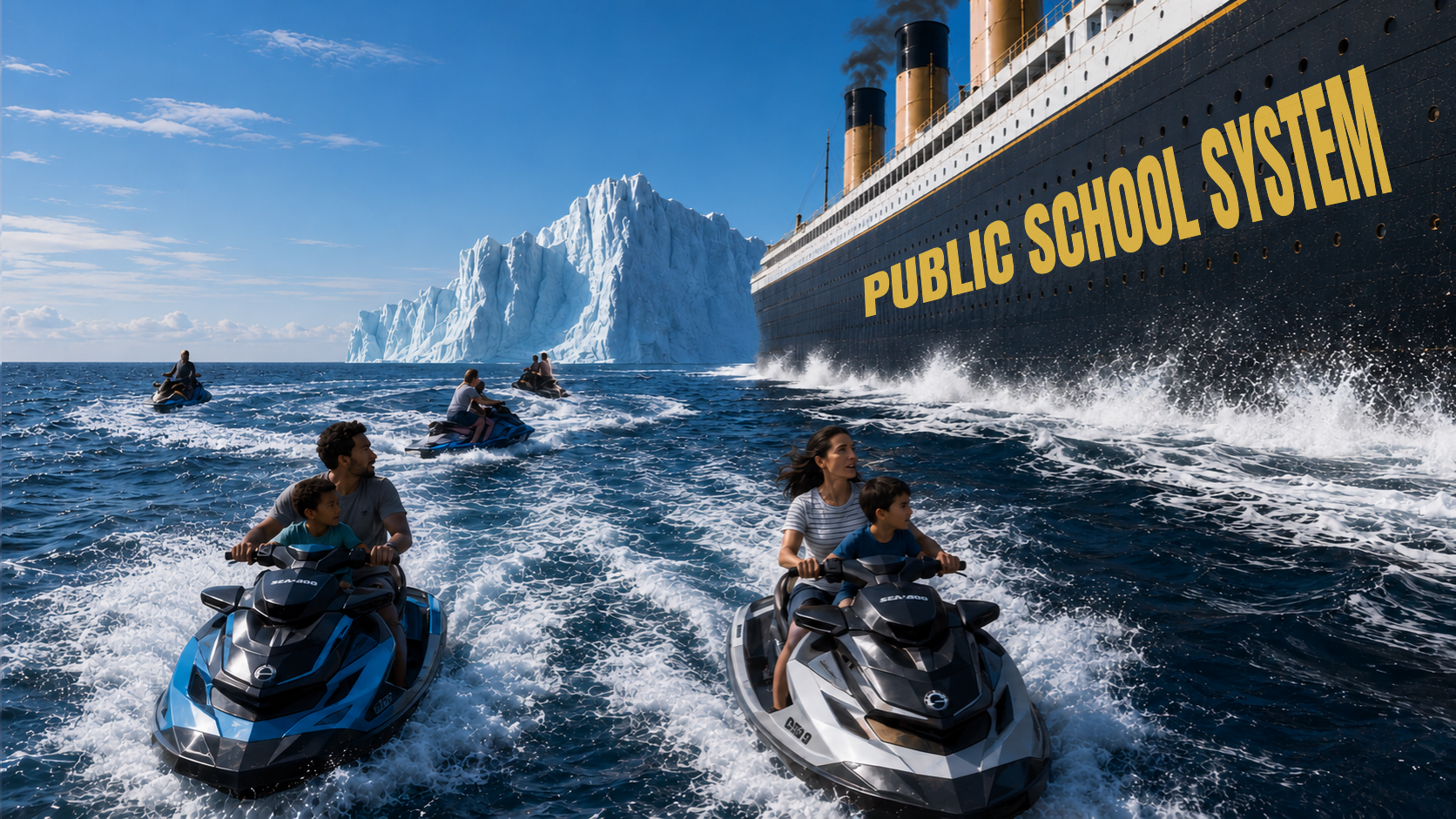
In that sense, modern education can feel a little like the “unsinkable” Titanic.
Impressive. Confident. Expensive. Filled with people who assume something that large must also be safe.
But when the world changes quickly, size can become a weakness.
A giant ship can see the iceberg and still struggle to turn in time.
Private schools, homeschool families, and alternate parent-led education models are different. They are not giant ships. They are more like families on jet skis.
Smaller. Faster. More personal. Able to adapt and change direction almost instantly.
When a mom realizes her teen needs AI literacy, entrepreneurship, financial skills, communication practice, emotional resilience, or real-world project experience, she does not need to wait ten years for a curriculum committee to write, debate, then approve it.
She can start this week.
That may become one of the greatest advantages of modern homeschooling and alternative education. It is not merely an escape from a system parents dislike. At its best, it is an agile education model for a rapidly changing world.
Homeschooling Is an Indicator of a Larger Problem
Homeschooling has continued to grow in the United States, and that matters.
Not because every family should homeschool.
But the growth of homeschooling tells us something important.
More and more parents are no longer willing to outsource every major educational decision to institutions that may not share their urgency, values, or vision for their child’s future.
They are leaving because they see a disconnect on what best aligns with what they want for their children.
They want more flexibility and customization. More safety. More purpose. More room for their child’s gifts. More connection between learning and real life.
And now AI has made that concern even more urgent.
Because AI is not just another subject.
AI changes how students write, research, create, study, cheat, build, communicate, and eventually work.
A school can tell a student, “Do not use AI on this assignment.”
A parent can teach a teen, “Here is how to use powerful tools with honesty, wisdom, and self-respect.”
Those are not the same lesson.
Harvard Saw the Disconnect Years Ago
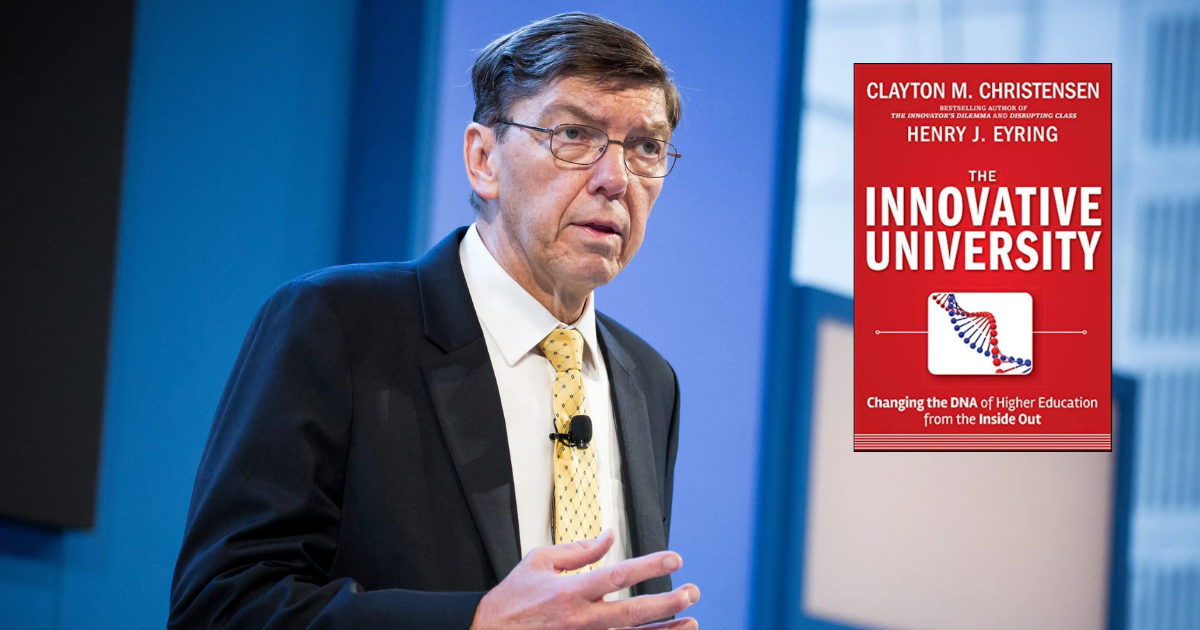
Harvard Business Professor, Clayton Christensen, warned that education was vulnerable to disruption.
His point was not that every school building would vanish overnight. The point was that traditional education had become expensive, rigid, and increasingly disconnected from what many learners actually needed.
That warning feels even more relevant now.
For a long time, schools and universities had a kind of monopoly on knowledge.
If you wanted access to expert instruction, specialized information, credentials, and career pathways, you usually had to go through the institution.
That world is fading.
Knowledge is abundant now.
Instruction is everywhere.
Your school has access to the best math educator in your town.
The internet has access to the best math educators in the world.
AI can explain, tutor, translate, summarize, generate examples, quiz students, give feedback, and help students build things that once required teams of adults.
So what becomes scarce?
Not information.
Wisdom.
Not access.
Discernment.
Not content.
Character.
That is the shift parents need to understand.
The future of education will not be defined only by what students know. It will be defined by what they can do with what they know.
Can they think clearly?
Can they ask better questions?
Can they use AI without becoming dependent on it?
Can they create instead of merely consume?
Can they solve real problems?
Can they build something useful, beautiful, honest, or helpful?
That is future-ready education.
AI Is Too Powerful to Ignore and Too Risky to Hand Over Casually
This is where parents can feel stuck.
On one side, ignoring AI is not a serious plan. AI is being integrated into the workplace, entertainment, search, writing, design, coding, health care, and almost every creative field.
A teen who graduates without AI literacy may not just be behind in technology. They may be behind in how modern work gets done.
On the other side, handing a teenager unlimited AI access with no guidance is also not wise.
AI can help a teen learn faster.
It can also quietly replace effort.
It can help a student brainstorm, practice, revise, and improve.
It can also do the thinking for them while they slowly lose confidence in their own mind.
That is why Waypoint’s position is not anti-AI and not blindly pro-AI.
AI is too powerful to ignore and too risky to hand over casually.
The goal is guided preparation.
Teens need to learn how to use AI as a coach, not a crutch.
They should think first, try first, and use AI second.
They should learn how to ask better questions, check answers, protect their attention, guard their integrity, and use AI to create real value.
That is what AI literacy really means.
Not just prompting.
Wisdom. Integrity. Discernment. Skill.
Parents Do Not Need to Become Tech Experts
Here is the good news.
Parents do not need to know everything about AI to lead wisely.
You do not need to understand every model, app, update, plug-in, workflow, and weird new tool name that sounds like a rejected Star Wars droid.
You need to understand your role.
Your role is not to become a Silicon Valley engineer overnight.
Your role is to guide your child while they are still in your care.
That means asking better questions.
“What did you use AI for?”
“What part did you do yourself?”
“Did AI help you think more deeply, or did it help you avoid thinking?”
“Can you explain this in your own words?”
“Did this make you more capable?”
“Was this honest?”
Those questions are powerful.
Because good kids still need good systems.
Even honest teens need structure. Even bright teens need practice. Even motivated teens need adults who help them slow down and think clearly.
The families who do best in the AI age will not be the ones who panic.
They also will not be the ones who shrug and say, “Kids will figure it out.”
The families who do best will be the ones who lead.
Calmly. Consistently. Wisely.

The Future Belongs to Guided Builders
The old education model often trained students to complete assignments.
The next education model must help students build their capability.
That does not mean we abandon math, reading, writing, history, science, art, faith, family, or moral formation.
The humanities are not obsolete. But humanities without technological literacy and real-world application are becoming incomplete.
Technical skill is not enough either. Skill without wisdom can become dangerous.
The future does not belong only to kids who can code.
It belongs to kids who can think, discern, communicate, create, collaborate, solve problems, and use powerful tools without losing themselves.
That is the heart of future-ready education.
And parents do not need to wait for the giant ship to turn.
They can start leading from home.
They can start with conversations.
They can start with better rules.
They can start with one guided project.
They can start by teaching their teen to use AI as a coach, not a crutch.
They can start by helping their child move from passive student to capable creator.
That is preparation.
Waypoint helps families raise safe, capable, future-ready teens in the age of AI. Inside our AI Pathfinder Certificate, teens learn how to use AI wisely, honestly, and creatively, without letting it do the thinking for them.