You May Not Get a Vote on AI. But You Still Have a Choice.
“Mitigating the risk of extinction from AI should be a global priority alongside other societal-scale risks such as pandemics and nuclear war.” - Sam Altman, CEO of OpenAI
I get it. You are worried about what AI is going to do to the future. You are worried about massive job loss. About deepfakes making it harder to know what is real. About children becoming dependent on machines. About surveillance. Autonomous weapons. Powerful corporations collecting even more data. Governments gaining tools we may someday wish they did not have.
And somewhere underneath all of that is an uncomfortable feeling:
Why does nobody seem to be asking us?
Who decided we wanted this?
Who gets to determine how these systems are trained, what values they reflect, how powerful they become, and where they are eventually deployed?
Why don't ordinary families get a vote?
Those are reasonable questions.
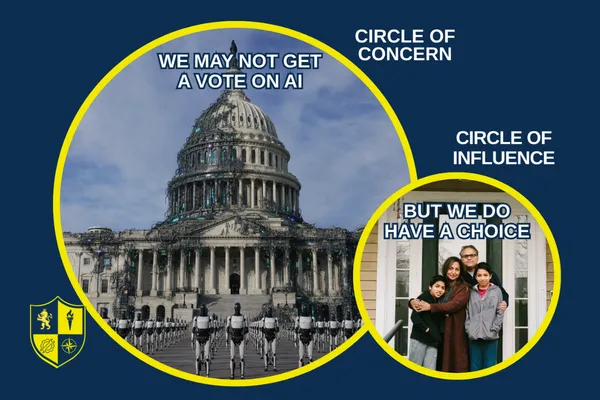
And they reveal just how enormous our Circle of Concern around artificial intelligence has become.

Our Circle of Concern Is Enormous
Stephen Covey popularized a useful distinction between our Circle of Concern and our Circle of Influence.
Our Circle of Concern contains everything we care about, including what worries us.
Our Circle of Influence contains the things we can actually do something about.
AI has created one of the largest Circles of Concern humanity has ever experienced.
We can worry about what Silicon Valley billionaires are building.
We can worry about military applications.
We can worry about what China, Russia, the United States, or any other country might develop.
We can worry about a brilliant researcher somewhere deciding to push a system farther than everyone else thinks is wise.
We can worry about whether governments regulate AI too much, too little, too slowly, or in completely the wrong way.
Some of those conversations matter. Citizens should ask questions. Governments should establish wise laws. Companies should be held accountable. Experts should debate safety.
But there is also a difficult truth worth acknowledging.
You and I have very little direct control over most of it.
Even if you successfully influenced AI policy in your own country, you would still have no veto over what another nation develops. You cannot personally decide what happens inside a classified defense laboratory or what technology gets trained on servers halfway around the world.
That realization can create an enormous sense of helplessness.
And helpless people usually do one of two things.
They obsess.
Or they retreat.
Neither is a particularly good strategy for raising children.
We May Be Staring So Hard at the Risks That We Miss the Possibilities
There is another problem with spending too much time inside our Circle of Concern.
We begin seeing AI primarily through the lens of everything that could go wrong.
And plenty could.
Waypoint has never argued that parents should casually hand this technology to children and hope for the best. AI is too powerful to ignore and too risky to hand over casually.
But risk is only half the picture.
Something extraordinary is happening at the same time.
A teenager can now have access to a patient tutor who can explain algebra twelve different ways.
A young artist can learn animation.
A student with an idea for a business can research a market, develop a brand, build a website, create promotional materials, and test the idea in days rather than months.
A teenager curious about programming can build something before taking a formal computer science class.
Young people can create documentaries, compose music, write books, design products, analyze data, learn languages, explore careers, study history, prototype inventions, and tackle real problems in their communities.
A child who once needed an entire team of skilled adults to bring an idea to life may increasingly be able to begin with curiosity, persistence, good judgment, and a laptop.
That deserves our attention too.
We are understandably asking:
What might AI take away from our children?
We should also be asking:
What might our children become capable of because this exists?
Those two questions belong in the same conversation.
Technoresistance Feels Like Control
When parents feel powerless about a technology, resistance can feel reassuring.
Ban it.
Block it.
Boycott it.
Keep it out of the house.
Maybe if our children never touch AI, they will be protected from everything we are worried about.
There may absolutely be situations where boundaries or restrictions are appropriate, especially depending on a child's age, maturity, or the particular tool.
But avoiding AI altogether carries its own risk.
Our children are going to inherit a world saturated with intelligent systems.
They will encounter AI in university, employment, medicine, finance, entertainment, transportation, government, and almost certainly professions that do not even exist yet.
Keeping them away from AI does not necessarily prepare them to live wisely in that world.
It can simply postpone the moment when they have to figure it out.
I'd rather help them figure it out while we are still sitting beside them.
Our Circle of Influence Begins at Home
This is where the conversation becomes much more hopeful.
You may have almost no influence over how a foreign military uses artificial intelligence.
But you have enormous influence over how a twelve-year-old sitting across your kitchen table learns to use it.
You can teach your children that intelligence and wisdom are different things.
You can teach them to think before asking AI to think for them.
You can show them how to verify information rather than blindly trusting a confident answer.
You can establish family standards around privacy, cheating, pornography, manipulation, and honesty.
You can help them use AI to develop abilities instead of quietly replacing them.
And perhaps most importantly, you can help them discover what this technology makes possible.
Try starting with a few simple family questions:
What could we learn with AI that used to feel too difficult?
What could we create together that we could not have made a few years ago?
Whose problem could we solve?
How could AI help one of our children develop a talent rather than avoid the work of developing it?
Where should our family draw boundaries because something is possible but not wise?
Those conversations matter.
They move AI out of the abstract world of billionaires, robots, regulation, and geopolitical competition and bring it into the place where we actually possess meaningful influence.
Our homes.
What If We Put More Energy Into Tomorrow?
There will continue to be reasons to worry about artificial intelligence.
Some of them will prove justified.
Others will probably look almost comical in hindsight.
We cannot know yet.
But imagine what might happen if families dedicated as much energy to preparing wisely for tomorrow as we currently dedicate to feeling powerless about today.
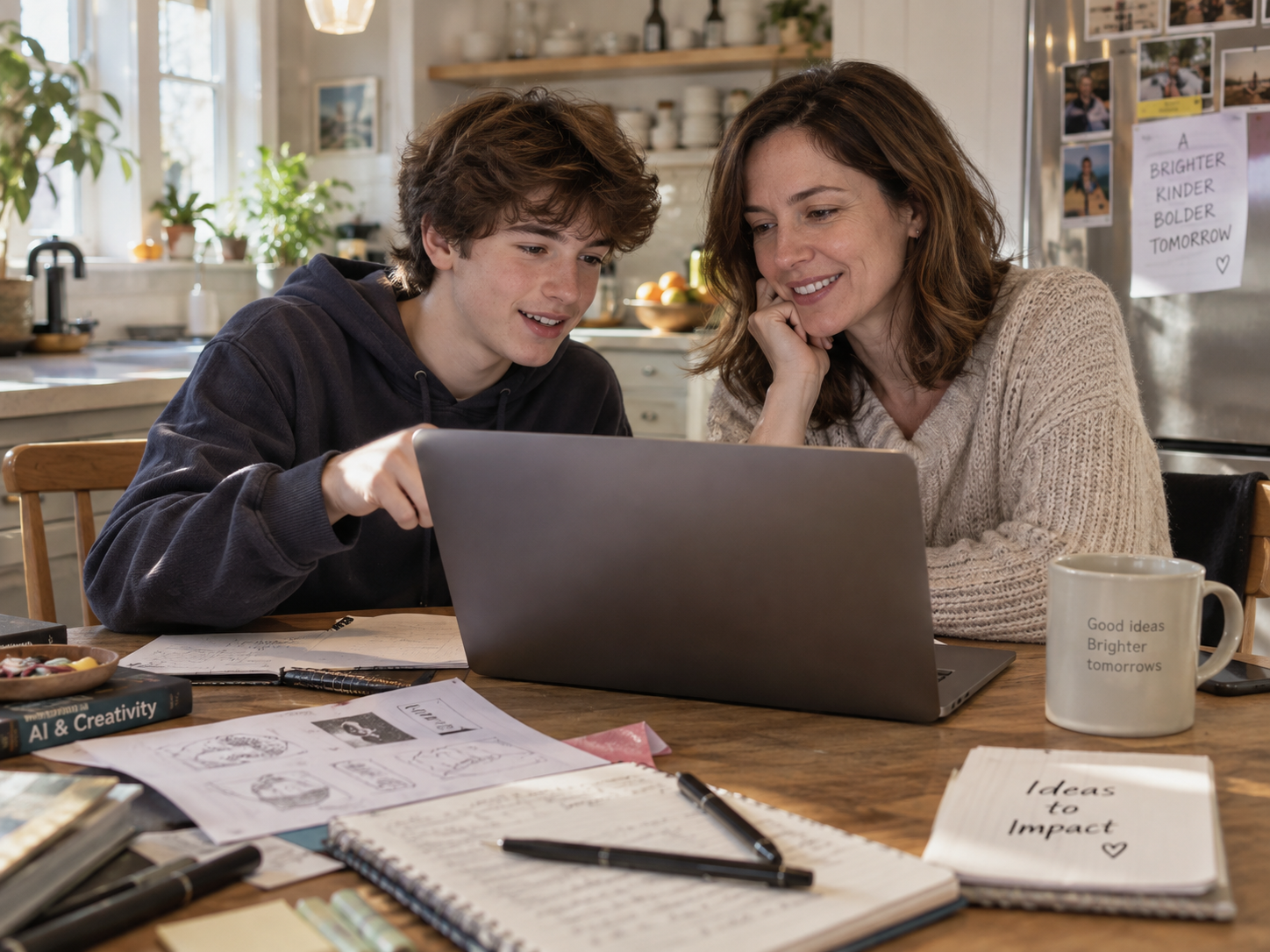
What if parents became curious alongside their children?
What if families explored AI together instead of allowing teenagers to encounter it almost entirely alone?
What if our children learned from us that powerful technology comes with moral responsibility?
What if they entered adulthood already knowing how to use artificial intelligence to create, serve, build, solve, and lead?
That future is inside our Circle of Influence.

And that is where I think most of our energy belongs.
Keep asking hard questions about what governments and technology companies are doing.
Vote.
Speak up.
Demand accountability.
Then come home.
Sit beside your child.
Open the laptop.
And start preparing together.
You may not get to decide everything AI becomes.
But you still have tremendous influence over who your children become while using it.
At Waypoint, that is the future we are preparing families for: children who can use extraordinarily powerful technology without surrendering the character, judgment, creativity, and humanity required to use it well.